Unhealthy Relationships: The Love Bomb

Me at 18… In hindsight, I wonder why I was so insecure.
When I was seventeen and eighteen, I was a model. I wanted to go to New York City and eventually become an actor. The truth was, however, I was very insecure in my own skin. Insecurities are totally normal, but looking back, it’s probably a good thing I didn’t follow that “dream.” My soft heart, naive understanding of the world, and insecure mindset would have been a terrible combination in a cutthroat world like that.
Those are also qualities that are easily manipulated.
When I was writing The Messy Truth About Love, I went back to this girl when I started writing Hannah. Though Hannah isn’t me (she’s a fictional character), I thought about how insecurities informed the way I interacted with the world and was curious about how that might be true for Hannah. It made me wonder: What happened to Hannah? I had to dive into Hannah’s character’s past to truly understand her present and began to see the red flags of a young woman who’d suffered through an abusive relationship. A deep dive into kinds of behaviors people might experience and not necessarily identify as a red flag to potential abuse sparked my curiosity. One red flag was waved time and again: Love bombing.
What is Love Bombing? In a nutshell, it’s the extreme romantic attention offered quickly and intensely as a means to influence feelings and is often a tactic used by narcissists to control their partners.
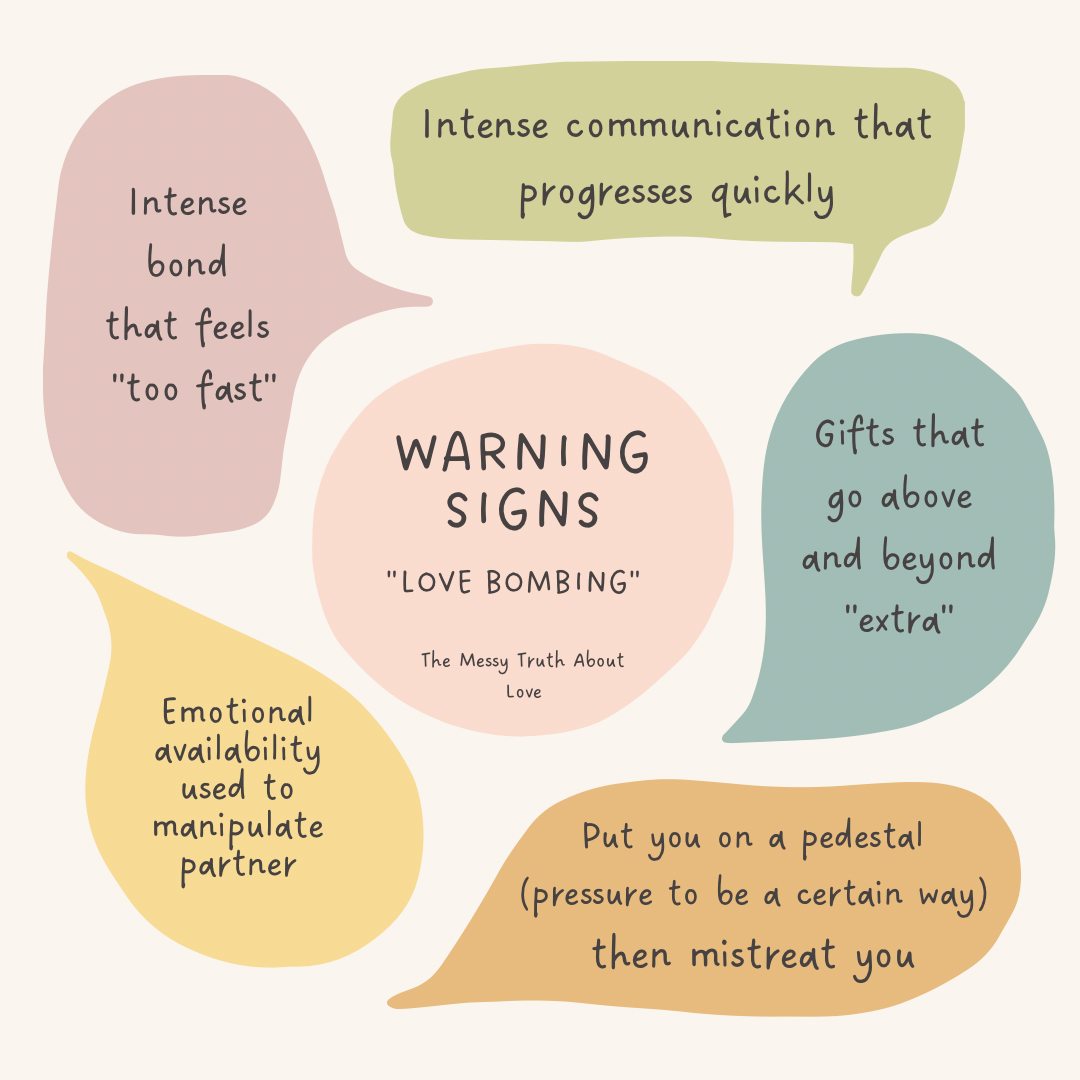
Keep in mind, I am not a psychologist or a therapist. What I’m sharing with you is what I’ve learned as a writer through research (if you feel you might be in an abusive relationship, PLEASE GET HELP IMMEDIATELY). This is a scene I wrote for The Messy Truth About Love. It ended up on the cutting room floor in final edits due to pacing issues, here’s a part of it showcasing what love bombing might look like:
The trees flew past as if they were moving, rather than the car speeding down the highway on the way toward the Oregon coast. Sebastian had planned something special for our first Valentine’s Day celebration. It was technically our fourth date, but since our first coffee date, we’d spent at least some part of everyday together the last several weeks. He made it so hard not to be crazy about him.
As if he’d read my thoughts, he reached across the center console and took my hand in his. “I’m so glad you’re here with me,” he said and smiled. “You’re the best thing that’s ever happened to me. I’m so excited for your surprise. To show you how much you mean to me.”
My heart tightened in my chest, and I squeezed his hand with mine. “Me too,” I said, offering a smile.
We rode in silence for another few miles. Sebastian sang along to the playlist he’d made. He’d titled it “Our first Valentine’s Day.”
“Do you think we’re moving too fast?” I asked.
It was only our fourth date, after all. We’d met for coffee the day after meeting in the library. I still got that warm glow remembering what he’d said, “that first time I saw you, Hannah. I wasn’t sure I’d be able to breathe again without talking to you.” I’d made a quip, and he smiled, his eyes twinkling, and said, “Good thing you talked to me.”
The second date had been to a rib place in Salem. We’d worn bibs and gotten messy faces, laughed, and talked about our lives. He’d shared about his crazy ex-girlfriend who had been ultra-controlling, and how that experience had shaped his struggle to put himself out there again. I’d shared with him that I’d never really had a boyfriend, a few near misses but several crushes, one I thought about from time to time. Sebastian had smiled and said, “lucky for me.” I kept my shame about the night my father died to myself. On that date, I’d reached out and used my thumb to clean off a spot of sauce near the corner of his mouth that he’d missed with his napkin. Sebastian’s eyes had met mine, and there was a shift between us toward something more physical. We shared our first kiss against his car before returning to his apartment to watch a movie. It was weak-kneed wonderful.
Our third date was to an art museum in Portland. We’d wandered the halls hand in hand, stopping to kiss. Sebastian snuck nips at my neck, wrapped me in his arms, held me tightly against him. “Hannah Fleming. You’ve got me all tied up in knots,” he’d said against my skin. After, as we walked back to the car, he’d pulled me into a floral shop and bought me as many bouquets of roses as I could hold. When we’d made it back to his car, he’d driven us to a park next to the river where we’d made out like teenagers, surrounded by roses. We talked about our dreams, and I walked in my apartment with him that night feeling as if it had been a dream.
Though this kind of attention can initially seem acceptable in the intensity of a “new relationship”, attempting to identify the giver’s motives is important to ascertain their sincerity. Love bombing can lead to more problematic and abusive behaviors like gaslighting and isolation, and isn’t the only time those in a relationship might experience it. Love bombing can also occur after explosive fights or abusive episodes when the abuser desires to “smooth over” their abuse by using effusive words and actions to manipulate a victim toward “forgiveness.” One of the quickest ways to identify whether you are the victim of Love Bombing is to ask yourself if you feel manipulated.
For example:
Your partner describes you in a manner that is flattering and seems to put you on a pedestal to “worship” you. The words they use might be exactly what you need to hear, speaking to you on a very emotional level.
The Love Bomber in this instance is manipulating the emotional connection with words but also setting up future “isolation” since no one can “live up” to you.
Your partner might offer you high praise and then in the next breath belittle you to “keep it real.”
The Love Bomber isn’t about you or the relationship but rather controlling you via your emotions. This will serve to manipulate and unbalance you, feeding into your insecurities to showcase how dedicated the Love Bomber is to you.
Your partner loves public displays of affection, with social media posts or showing you off because they are so “in love” or so “lucky” to be with you.
This elaborate display for a Love Bomber is the means to present the “perfect” romance giving them the attention they crave rather and building an authentic relationship with you.
Your partner showers you with grandiose gifts. We love receiving gifts, right? These gifts come with price tags.
A Love Bomber will use the gift as a means to showcase their devotion and remind you of what they have done for you. This will make you “feel bad” for all they have done which in turn keeps you locked in the relationship.
Your partner showers you with early “I love yous” and then withdraws the affection without cause.
Remember a Love Bomber is all about manipulating your emotions. Drawing you into an intensely emotional relationship and then “leave you hanging” is a classic means of manipulation.

Perhaps you recognize some of the above signs in your relationship, but you aren’t sure if you’re being manipulated? Here are some questions to ask yourself:
Ask yourself: Am I comfortable with this person’s attention or is it a “bit much”?
Remember that a true Love Bomb is a manipulation tactic. If the attention feels too big and self-serving (for the giver), it probably is. Trust your instincts.
Ask yourself: Am I afraid to confront my partner for fear of their reaction?
Your desire to keep the peace might be more connected to an abusive response by your partner who might berate you, gaslight you, or guilt you.
Ask yourself: Is my partner respecting my boundaries?
A partner who ignores your boundaries isn’t offering mutual respect. For example, perhaps you told your partner you are planning a night out with your friends. Your partner agrees but on the date of the event, begins to use emotional tactics to manipulate you to not go. Or maybe you’re out and your partner shows up to “crash”. These techniques exemplify crossing boundaries.
While I can’t say I know everything about this topic, (I don’t and I’m not a psychologist or therapist which is who I urge you to discuss your experiences with) I wanted to offer some bits I learned in my research. Here are some additional resources to guide you:

Healthy Relationships: Hindsight is 20/20

During my junior year in high school, I went through a breakup with a long-term boyfriend of over a year (which hadn’t been a very healthy relationship and is a story in and of itself). I wasn’t in a very good place emotionally and my confidence was at an all-time low.

I wasn’t in a place to date…
My confidence and sense of self was at an all-time low.
I didn’t share these things with anyone. I think maybe at that time in my life, I was under the impression that I should have it “all together” because I thought the people around me did. I didn’t talk to my parents (because the confusion about dating, relationships, and sexuality weren’t discussed beyond the “religious” lens and often left me feeling guilty and confused). My friends had sort of exploded and we were shrapnel spread out, though not because of anything dramatic but rather the natural drifting on the winds of changing ideologies and exciting, new relationships. Add to it that I was embarrassed; I’d had sex for the first time with that long-term boyfriend, believing that relationship was going to be “forever”, and it was only weeks later he broke up with me.
I was the stereotype.
Sometime later, when a new boy asked me out—a friend—I agreed. I believed he was a nice guy, and I thought getting to know him a bit more was a good thing. He had a ready smile, a nice sense of humor, and was cute. We started hanging out more in the normal ways: spending time at school flirting and laughing, exchanging notes written on notebook paper in the hallway between classes, and talking on the phone (this is before cell phones). We even went out in a group setting several times before finally venturing out on a date between the two of us. I can’t even tell you where it was, but I know we ended up at his house to watch TV. Somehow, during the course of watching TV, we shared our first kiss.
It wasn’t great. There were no fireworks or butterflies. No chemistry at all.
My brain screamed: disengage! I pulled away from him, and because I’d been taught to be a nice girl and to spare another’s feelings, I did my best to extricate myself from the intimate situation with as much grace as I could muster. Only he didn’t read the cues. Instead, he grabbed my hand and put it on his junk; then he proceeded to hold my hand against him to try and force me to give him a hand job.
I said “no”, pulled away, and fled the scene (thankfully, I’d driven) disturbed by the events. Had I missed something? What had I done wrong? Did I make him think that was okay? I thought he was nice! Why had he tried to force me to do something like that?
The next day, I told him I didn’t like him in “that” way and hoped we could remain friends (current me scoffs and rolls her eyes). We didn’t. He was a jerk to me after. Rather than having the ability to see that he had been the one in the wrong—consent, nonexistent—I took his dismissal of me as my failure.
Fast forward to now—and without getting into the bigger issue of consent, sex assault, and the inappropriateness of my self-blame (because these are separate things)—the experience reminds me how important it is to be in a positive headspace as an individual when starting a new relationship. That doesn’t mean, of course, that people don’t bring experiences that hurt them, impact their sense of self, so on and so forth, into a relationship. That’s impossible. It also doesn’t mean that the right person potentially can support our growth through trauma. In this instance, however, I wasn’t in a healthy headspace to walk into a relationship with this immature, young man. My struggle to see my own worth provided me the perfect means to focus on my shortcomings rather than trust my instincts. I’d lost my sense of self, lost all my confidence in what I believed and what I thought I knew. I was grappling with guilt over my own sexuality and was in over my head without the tools necessary to advocate for myself, to be clear about what I deserved and wanted, as well as what kind of treatment to demand from a partner.
Hindsight is 20/20, of course.
Perhaps my hindsight can be your foresight.

If I had access to a time machine and I could go back for a do-over, I wouldn’t have gone out with him in the first place. I would have thanked him for being my friend, but told him I wasn’t in a place to date anyone. The truth was, I didn’t have feelings beyond friendship for him, but I appreciated his attention considering the pain of being dumped and how raw I felt. A horrible combination. Had there been sparks or chemistry (thank goodness there weren’t, I was primed to accept the manipulation of a lovebomb or the eventual unhealthy stance of a possible abuser [not that this young man fit either of these descriptions, nor do I presume this is who he was beyond our failed date]). And, if I had had a mentor to offer advice, I hope they might have told me: Perhaps hold off on dating anyone until you navigate the feelings you're feeling about your ex and you deserve more than what you’re telling yourself.
The sad news is that I didn’t do any of those things, and this experience primed me for several more unhealthy relationships (current me is shaking her head). It’s embarrassing, but I don’t think I’m probably alone. On a positive note, however, if I could help to make the awful cycle stop, I’ll offer these mentorship tips now:
If you’re struggling with a break-up, hold off dating anyone. You need to reconnect to your inner-strength. Allow it to bloom and feed you before dating and sharing it with another.
Don’t allow someone else to determine your self-worth.
Expect more, not less.
Don’t make excuses for your partner, and recognize your feelings are valid.
Speak up. Stand up. Walk away (when the behaviors your partner exhibits are problematic, disrespectful, and/or isolating).
Don’t silence your inner-voice; trust your instincts.

In the new book, The Messy Truth About Love, I get the opportunity to offer a contrast between what’s healthy in a relationship with an unhealthy version of one—a sort of mentor to my fictional characters (LOL). Hannah is two months removed from a relationship when she reconnects with her high-school-crush Seth in The Messy Truth About Love. I’m not sure she follows my six point advice here, but she’s on the mend as she runs into Seth, so we get to witness her grow through it with Seth as one of her mentors. This story had difficult moments to write, but important ideas, nonetheless. Be aware of trigger warnings before you pick it up (which I’ve published here, but there are spoilers). The Messy Truth About Love comes out September 6, and if you’re interested in some deleted scenes, here’s a link.
Relationships: Beware Gaslighting

This isn’t a blog to explore the how, the what, the what-to-do with respect to gaslighting. Remember I’m not a psychologist or a therapist, just an author who’s done a bit of research for their book (Here’s a link to a resource written by someone more in-the-know than I am). The purpose of this blog is to consider gaslighting in terms of the “everyday” relationship. Ultimately, this sinister form of manipulation culminates when the victim questions their sanity, but that’s not how gaslighting begins.
Relationships are tricky creatures from the get-go. Typically two people with distinct personalities are working to come together and maintain a bond. This is difficult for two people with completely healthy approaches to relationships and communication. Add complicating factors like mental health issues, trauma and/or abuse, addictions, different perspectives, varied life experiences, so on and so forth, and the playing field went from being rolling hills to the Rocky Mountains.
Gaslighting, then, is one of those insidious tools used between partners to manipulate the other’s emotions. Like the love bomb, it isn’t necessarily something that is easily identifiable, especially when trust has been established in a relationship and if you aren’t sure what to look for. Here’s an example of how gaslighting might look in a typical relationship:
Let’s pretend you’ve had the feeling that your partner isn’t being completely honest with you about what they’ve been doing. Your spidey-senses are tingling, so you decide it's time to ask about some things you’ve noticed, at least to calm your insecurities. When you ask your partner about the late nights and the strange hushed phone call from the other night, your partner twists your questions back on you as if what you’ve made are accusations, and suddenly you’re being accused of being a liar. That perhaps you’re “making up '' mysterious phone calls and accusing your partner of being late because you’re doing something wrong while they’re away. Your partner might say, “Guilty people make accusations about what they’re doing wrong to deflect, afterall.” Your partner’s guilt trip about your lack of trust and oversensitivity throws you off since that’s not what your intentions were. Right? Maybe your partner is right. You struggle to recalibrate your thoughts, because what started as just a conversation to “clear the air” has you defending yourself, doubting your intentions and your feelings, along with doubting your instincts.
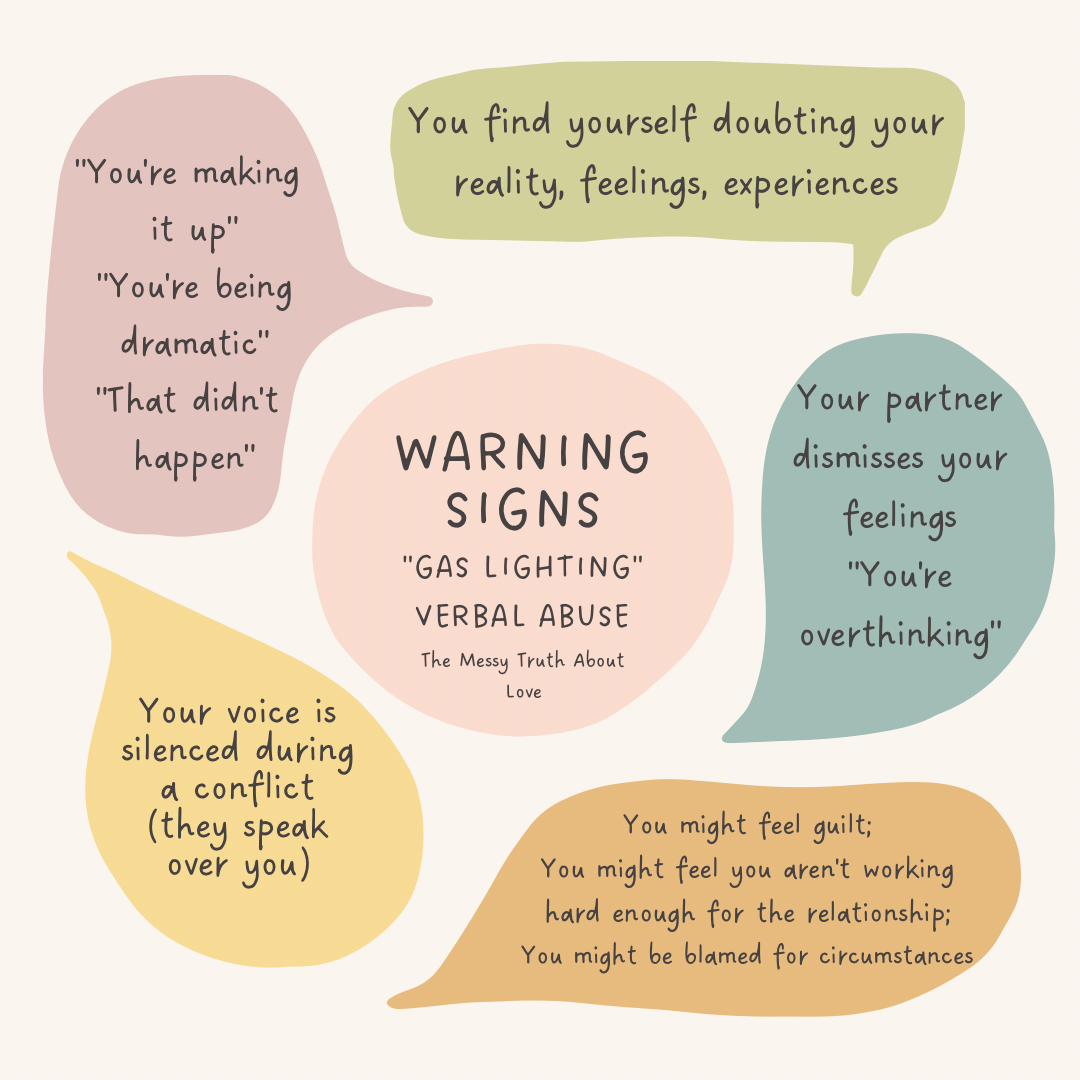

The thing is, even normal, everyday, regular people can deploy a “gaslight”. This isn’t only a tool of the shady or the narcissist or the sociopath. It is a learned tool—a form of avoidance and deflection—which makes it important to be able to identify one and call the behavior out immediately. In The Messy Truth About Love, Hannah’s ex-boyfriend used this technique, calling her “over-sensitive” and “dramatic”. The awful thing about persistent gaslighting even in a “typical” relationship is the ugly way it preys on beliefs about self, feeding on insecurities and forcing those wounds to grow and fester.
If your partner uses this tool, it's important to call it out for what it is. You might need help with this, so find help! And if your situation is abusive, seek help immediately.

Blog Digest from 2018-2023
-
March 2026
- Mar 23, 2026 The Cipher of Tolo Mar 23, 2026
-
January 2025
- Jan 17, 2025 Bring Back the Dystopian Craze of 2012 Jan 17, 2025
-
July 2024
- Jul 15, 2024 Imposter Syndrome: Tools for Authenticty Jul 15, 2024
-
June 2024
- Jun 1, 2024 June Read Along: In the Echo of this Ghost Town Jun 1, 2024
-
March 2024
- Mar 25, 2024 New Post on SubStack tomorrow! Mar 25, 2024
- Mar 1, 2024 March Read Along: The Bone of Who We Are Mar 1, 2024
-
January 2024
- Jan 31, 2024 February Read Along: The Ugly Truth Jan 31, 2024
-
December 2023
- Dec 28, 2023 2024: Year of the Read Along Dec 28, 2023
-
October 2023
- Oct 25, 2023 Unhealthy Relationships and Romance Books Oct 25, 2023
- Oct 25, 2023 Relationships: Isolation versus Autonomy Oct 25, 2023
- Oct 22, 2023 Unhealthy Relationships: The Love Bomb Oct 22, 2023
- Oct 22, 2023 Healthy Relationships: Hindsight is 20/20 Oct 22, 2023
- Oct 22, 2023 Relationships: Beware Gaslighting Oct 22, 2023
-
September 2023
- Sep 25, 2023 Blog Digest from 2018-2023 Sep 25, 2023
-
August 2023
- Aug 26, 2023 Blog Moved to Substack Aug 26, 2023
-
July 2023
- Jul 31, 2023 The Trials of Imogene Sol: The Allies Jul 31, 2023
- Jul 13, 2023 Foundational Books & Book Bans Jul 13, 2023
- Jul 5, 2023 Tropes: Found Family Jul 5, 2023
-
June 2023
- Jun 21, 2023 3 Things I Learned About Reading Space Opera Jun 21, 2023
-
May 2023
- May 24, 2023 The Dangers of Myopic Reading May 24, 2023
- May 17, 2023 My Trek...Journey...Quest to O'ahu Independent Bookstores May 17, 2023
- May 10, 2023 My Life as an Alien Invader May 10, 2023
- May 3, 2023 How I Got to Hawaiʻi, My Hawaiʻi Story May 3, 2023
-
April 2023
- Apr 26, 2023 You Can Go Home Again Apr 26, 2023
-
March 2023
- Mar 29, 2023 Cantos Love: Happy Anniversary! Mar 29, 2023
- Mar 22, 2023 Cantos Love: Gabe Mar 22, 2023
- Mar 15, 2023 Cantos Love: Seth Mar 15, 2023
- Mar 8, 2023 Cantos Love: How They Came to Be Mar 8, 2023
- Mar 1, 2023 Cantos Love: A Month of Cantos Mar 1, 2023
-
January 2023
- Jan 25, 2023 The Letters She Left Behind, 3 Years. Jan 25, 2023
- Jan 18, 2023 Behind-the Scenes: The Trials of Imogene Sol Jan 18, 2023
- Jan 11, 2023 Behind-the-Scenes: Reading & All My Rage Jan 11, 2023
-
November 2022
- Nov 16, 2022 Book Hangover List Nov 16, 2022
- Nov 9, 2022 Advice: Find your People Nov 9, 2022
-
October 2022
- Oct 26, 2022 Contest Awarded Short Story: The Invalid Oct 26, 2022
- Oct 13, 2022 The WHY Behind The Messy Truth About Love Oct 13, 2022
-
June 2022
- Jun 27, 2022 4 Things You Should Know about The Messy Truth About Love Before Reading Jun 27, 2022
-
February 2022
- Feb 2, 2022 February Ideals: Dreaming Feb 2, 2022
-
December 2021
- Dec 22, 2021 My Top 10 Songs (w/Lyrics) 2021 Dec 22, 2021
- Dec 15, 2021 My Top 5 Characters I've Written Dec 15, 2021
- Dec 1, 2021 My Top 5 of My Own Books Dec 1, 2021
-
September 2021
- Sep 1, 2021 Road to Echoes: 8 Tips for Using NaNoWriMo to Write Your Novel Sep 1, 2021
-
August 2021
- Aug 25, 2021 Road to Echoes: 4 Lessons I Learned Writing Maxwell Wallace Aug 25, 2021
- Aug 18, 2021 Road to Echoes: Tropes Aug 18, 2021
- Aug 11, 2021 The Road to Echoes: Loud Characters Aug 11, 2021
- Aug 4, 2021 The Road to Echoes: Putting the Story Together Aug 4, 2021
-
July 2021
- Jul 28, 2021 The Road to Echoes: Research to Understand Griffin Jul 28, 2021
- Jul 21, 2021 The Road to Echoes: Secondary Characters Primer Jul 21, 2021
- Jul 14, 2021 The Road to Echoes: Writing Difficult Characters Jul 14, 2021
- Jul 7, 2021 The Road of Echoes: What Inspired Griffin's Story? Jul 7, 2021
-
June 2021
- Jun 30, 2021 The Road of Echoes: New Blog Series Jun 30, 2021
-
May 2021
- May 26, 2021 Favorite Reads of 2021 So Far May 26, 2021
- May 19, 2021 Cover Love May 19, 2021
- May 12, 2021 Writing Limbo May 12, 2021
- May 5, 2021 Writing In Between May 5, 2021
-
April 2021
- Apr 28, 2021 April Challenge: Update No. 4 Apr 28, 2021
- Apr 21, 2021 April Challenge: Update No. 3 Apr 21, 2021
- Apr 14, 2021 April Challenge: Update No. 2 Apr 14, 2021
- Apr 7, 2021 April Challenge: Update No. 1 Apr 7, 2021
-
March 2021
- Mar 31, 2021 April Challenge: Finishing the Draft Mar 31, 2021
-
February 2021
- Feb 24, 2021 Character Speaks: Dear Paola, from Gabe Feb 24, 2021
- Feb 17, 2021 Character Speaks: Dear Sam, from Seth Feb 17, 2021
- Feb 10, 2021 Ask the Author: Advice for Newbie Writers? Feb 10, 2021
- Feb 3, 2021 Ask the Author: What motivates you to write? Feb 3, 2021
-
January 2021
- Jan 27, 2021 Ask the Author: Series or Stand Alone? Jan 27, 2021
- Jan 20, 2021 Ask the Author: Why did you choose to write YA? (Part 2) Jan 20, 2021
- Jan 13, 2021 Ask the Author: Why did you choose to write YA? Jan 13, 2021
- Jan 6, 2021 Ask the Author: Favorite Part of the Writing Process? Jan 6, 2021
-
October 2020
- Oct 16, 2020 Rainy Day Collective Podcast & Purity Culture Oct 16, 2020
- Oct 14, 2020 The Stories Stars Tell: It's Here! Oct 14, 2020
-
July 2020
- Jul 1, 2020 Interview: Lauren-Marie with The Indigo Book Jul 1, 2020
-
June 2020
- Jun 24, 2020 This-Then-That: YA Dystopian and SciFi Edition Jun 24, 2020
- Jun 17, 2020 This-Then-That: YA Contemporary Edition Jun 17, 2020
- Jun 10, 2020 This-Then-That: YA Fantasy Edition Jun 10, 2020
-
May 2020
- May 27, 2020 Reading Wonderland Interview: Piper Bee May 27, 2020
- May 20, 2020 Reading Wonderland Interview: Nancy Richardson Fischer May 20, 2020
- May 13, 2020 Reading Wonderland Interview: Rob Rufus May 13, 2020
- May 6, 2020 Reading Wonderland Interview: Lisa Brown Roberts May 6, 2020
-
April 2020
- Apr 29, 2020 Reading Wonderland: an Introduction Apr 29, 2020
- Apr 22, 2020 Quarantine: 37 Days Apr 22, 2020
-
March 2020
- Mar 31, 2020 Indie Author Marketing: Road Trip Wrap Up Mar 31, 2020
- Mar 25, 2020 Indie Author Marketing: Update No. 8 Mar 25, 2020
- Mar 18, 2020 Indie Author Marketing: Update No. 7 Mar 18, 2020
- Mar 11, 2020 Indie Author Marketing: Update No. 6 Mar 11, 2020
-
February 2020
- Feb 29, 2020 Indie Author Marketing: Update No. 5 Feb 29, 2020
- Feb 24, 2020 Indie Author Marketing: Update No. 4 Feb 24, 2020
- Feb 19, 2020 Indie Author Marketing: Update No. 3 Feb 19, 2020
- Feb 12, 2020 Indie Author Marketing: Update No. 2 Feb 12, 2020
- Feb 4, 2020 Indie Author Marketing: Update No. 1 Feb 4, 2020
-
January 2020
- Jan 29, 2020 Indie Author Marketing: A Hope and A Dream Jan 29, 2020
- Jan 15, 2020 The Letters She Left Behind: It's here! Jan 15, 2020
-
December 2019
- Dec 18, 2019 The Letters She Left Behind: Character Interview Dec 18, 2019
- Dec 11, 2019 The Letters She Left Behind: Annotated Playlist Dec 11, 2019
-
October 2019
- Oct 16, 2019 Awesome Writer Spotlight: Mary E. Pearson (again) Oct 16, 2019
- Oct 7, 2019 The Bones of Who We Are: Gratitude Oct 7, 2019
-
September 2019
- Sep 30, 2019 The Bones of Who We Are: It's time. Sep 30, 2019
- Sep 16, 2019 The Bones of Who We Are: A Difficult Story Sep 16, 2019
- Sep 9, 2019 The Bones of Who We Are: Journey to Gabe Sep 9, 2019
-
July 2019
- Jul 8, 2019 The Bones of Who We Are: Aesthetic Jul 8, 2019
-
May 2019
- May 26, 2019 Time Away May 26, 2019
- May 20, 2019 Writing Inspiration: Music May 20, 2019
- May 13, 2019 Awesome Writer Spotlight: Mary E. Pearson May 13, 2019
- May 6, 2019 Happy Book Birthday: A Character Interview May 6, 2019
- May 1, 2019 The Letters She Left Behind PLAYLIST May 1, 2019
-
April 2019
- Apr 29, 2019 YA Author Series - Author Spotlight: Genevieve Jane Apr 29, 2019
- Apr 15, 2019 YA Author Series - Author Spotlight: M. Wednesday Apr 15, 2019
- Apr 8, 2019 YA Author Series - Author Spotlight: Leslie Arambula Apr 8, 2019
- Apr 1, 2019 YA Author Series - Author Spotlight: Alison Aldridge Apr 1, 2019
-
March 2019
- Mar 25, 2019 YA Author Series Launch: CL Walters Mar 25, 2019
- Mar 12, 2019 Book Mash-Up Fun Mar 12, 2019
- Mar 4, 2019 Snappy Dialogue in 3 Minutes Mar 4, 2019
-
February 2019
- Feb 25, 2019 Pacing the Narrative: A New Tool Feb 25, 2019
- Feb 18, 2019 Character and Conflict Part2: Motivation Feb 18, 2019
- Feb 11, 2019 Character and Conflict, part one: Types of Conflict Feb 11, 2019
- Feb 4, 2019 Point of View and Writing Feb 4, 2019
-
January 2019
- Jan 28, 2019 Off to Refill the Well . . . Jan 28, 2019
- Jan 21, 2019 Character-Driven or Plot Driven Narrative? Jan 21, 2019
- Jan 14, 2019 Character: Conversations Jan 14, 2019
-
December 2018
- Dec 3, 2018 The Ugly Truth: Cover Reveal and Playlist Dec 3, 2018
-
October 2018
- Oct 29, 2018 This Writer Reads Oct 29, 2018
- Oct 8, 2018 Empathy is Our Superpower! Oct 8, 2018
- Oct 4, 2018 The Writer Hoard Oct 4, 2018
Blog Moved to Substack

Wondering where the blog went since it seems like it has been a while since I posted anything? I’m over on SubStack. Subscribe and each post (usually 1 time each week) is sent to your email. It’s a lot more convenient.
Let me know if there’s any topics you’d like to see me write about.
The Trials of Imogene Sol: The Allies
Character Art!!!
One more day until The Trials of Imogene Sol publishes. I can’t believe it’s almost here!
In celebration, I wanted to share with you some artwork I had commissioned and share a little bit about Imogene’s network of support.

The star of the show:

Imogene Sol has worked hard to be a top-10 cadet at The Ring Academy on Serta. When the Final Trials begin—tests to determine her job placement—she’s ready. Her hope to shed her infamous name—a name synonymous with her traitor parents—rides on her performance. When a mysterious saboteur interferes with her Trials, Imogene must uncover who’s behind the treachery but who can she trust? The stakes aren’t just for her future anymore but her life.
Here’s who she turns to for help:

Imogene and Vempur are best friends—as close as siblings. They’ve been their for one another since they both started at the Ring Academy in Year One.

Jenna became a friend to Imogene and Vempur when she started at the Academy in Year Three.
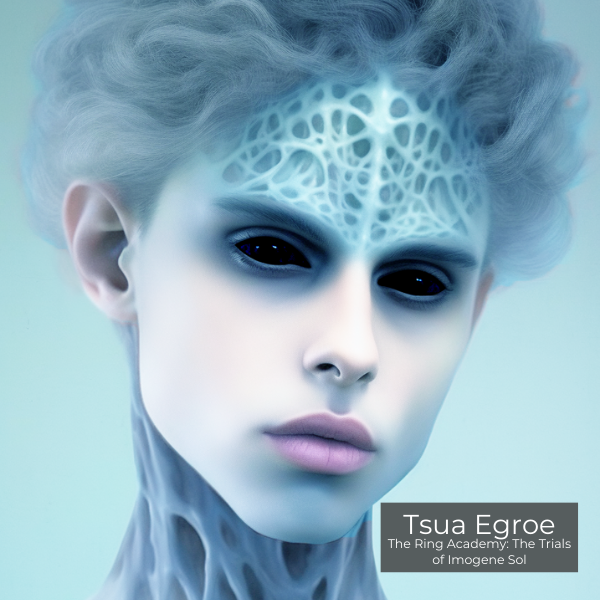
Tsua (pronounced: Zū uh) became friends with Imogene, Vempur, and Jenna when he was admitted to the Academy during Year Three.
Imogene’s newest ally—and the object of a crush she absolutely doesn’t want to acknowledge—is the academy Legacy student, Timeaus Kade:

I had so much fun writing these characters. I hope you enjoy them as much as I did.
Foundational Books & Book Bans
Yesterday on SubStack, I wrote about the importance of those books that define us as readers and how it relates to Book Bans. Here’s a link: Foundational Books and Book Bans

Tropes: Found Family
Tropes—a device utilized in stories—are potentially powerful tools because like cliches, they exist in a truth we as readers are able to relate to. One powerful trope is the found family (also called the family of choice). Defined “[this] trope refers to a device in literature [...] where a group of characters find themselves united in a family-bond based on shared experiences, mutual understanding, and interpersonal connection,” (www.nypl.org). Of the tropes that occur in The Ring Academy: The Trials of Imogene Sol, the found family is one of my favorites.

So, I thought it would be fun to share with you some popular books that utilize this trope:
General Fiction:
https://www.epicreads.com/blog/found-family-trope/
Romance edition:
https://www.shereadsromancebooks.com/found-family-trope/
Fantasy & Alternate History:
https://bookriot.com/found-family-fantasy-books/
If you’ve got a favorite book with this trope, I’d love to hear about it!
Source:
https://www.nypl.org/blog/2020/12/09/found-family-literature-celebrates-families-choice
3 Things I Learned About Reading Space Opera
I made mention of sci fi and dystopian in an earlier post (click here for that), but I’m circling back specifically considering the space opera. As a definition, space opera as a category is a story set in outer space that is typically simplistic in nature and dramatic. The most famous space opera: Star Wars. Nebulous futures, scientific explanations about flying through space, the end of the human race, robots, artificial intelligence, heroes who need to save the day. You get it, right? And with my focus on The Ring Academy: The Trials of Imogene Sol—which is most definitely a space opera—and its impending release, my mind is a bit preoccupied in this category.
So look…a lot of the same lessons I’ve mentioned from earlier posts apply here, but rather than be repetitive, here are three new ideas to twist the lesson which can be applied to any category of writing.
Asking the Right Questions
Read any info heavy science fiction novel (ah hem… Dune…) and you’ll understand that just like a fantasy story, it’s easy to get caught up in the minutiae of the information that defines the story. The problem, of course, is information dumping and information overload (which I’ll cover in a moment). This turns off most readers. What great writers in the category do well is parcel out information that is relevant to the necessary questions. Of course a reader has questions about the world, but not all the questions are necessary to the story. Not all of them fill in the gaps of the plot hole. While the author has a lot of the questions answered, that doesn’t mean the story needs all of them answered. The trick is identifying which ones need to be answered for the sake of the story.
One of my favorite dystopian writers is Paolo Bacigalupi (Ship Breaker, The Drowned Cities, and Tool of War). The cool thing that Bacigalupi does that I’ve seen some of my favorite fantasy writer’s employ is drop the reader right into the world and unfold the world around them as if the reader is already a member of the society. I LOVE this technique. A perfect literal example of this technique is The Maze Runner by James Dasher. The reader is Thomas dropped into the maze having to learn on the fly what’s what and how he fits in. The pros of this is that you avoid the pitfall of the info dump, and like the character, the reader uncovers the world and the conflict as they go.
There is inherent danger in losing the reader when an author embarks on information overload. I get the temptation to include all the cool things developed in world building, but just because it exists, doesn’t mean it’s relevant to the narrative arc. Well-written books in this category recognize this and employ an “as needed” methodology by understanding which questions need to be answered.
Which leads to the next point…
The Structure (the world and creatures)
Space opera (which encompasses Sci Fi/Dystopian) writers build worlds like fantasy writers, but then they destroy them. There is a methodology to this madness of course, even if they make it look effortless. But then consider that a wonderful fantasy story’s world is important to overall conflict from political machinations to traditions and systems impeding a hero’s journey. In Sci Fi/Dystopian the structure of the world and its demise is often the narrative architecture around which the conflict is built.
It’s clear when we enter habitat with Mark Watney in The Martian by Andy Weir, the structure of not only the immediate place is a functional place, but also that as a reader, the structure of the story is about survival. We are surviving with Mark, we are invested in his success, in the tension between learning he will connect with NASA. Or as we siphon through the missives of World War Z, the means by which author Max Brooks structured the novel makes it necessary to understand the hows and whys and what-fors in order to understand the movement of the narrative. The world, the creatures (think Alien) are so integral to the story, they can’t be removed or changed without impacting the overall narrative structure becoming a character in and of themselves.
Which then leads to:
Reader Story Interface
It might be easy to develop a story in this category so high above a reader’s understanding that it becomes inaccessible. But strong writer’s of this category make sure that the average reader is as much an expert as the scientist character or the super computer. Isaac Asimov is a great example of this. A very talented scientist (physicist), he was a pioneer in the science fiction realm of writing, making science fiction accessible (check out his Foundation series).
And really, that’s what any category is about right? Making the narrative accessible to the reader so that they fall in love with the story.
The Dangers of Myopic Reading
A Call to Read Widely
A few months ago, there was a Tik Tok that made its rounds on Booktok by a book reviewer (who happened to be white) commenting on the dark, academia fantasy Babel by R. F. Kuang. In the short review of the book, the review indicated that she hadn’t liked it because she couldn’t “identify” with it. Her reason why? Because she wasn’t Asian.
Hit the breaks.
Screech.
WTF?!!?
The Tik Tok review blew up and not in a good way. Commentary dragged the creator and for good reason. Ignoring the reviewer’s problematic assertion, which was racist at worst and bigoted at best (she has since removed the content so I couldn’t link it, which lends itself heavily to the assumption it was problematic), isn’t that—reading about alternative perspectives—why we read? Whether it's to challenge our perceptions about some big picture topic, to learn something new, to experience the emotions of a character’s experience, thereby gaining empathy. Aren’t these the reasons why we pick up stories?
Why do you read?
Maybe I’m a Pollyanna (for you youngins unfamiliar with old-school Diseny movies, that just means I look at the world through rose-colored lenses), my assertions about reading filled with naive idealism. For me, reading has always been about joy and emotion. I love romance novels because there is a beautiful rhythm of predictable happiness which offers me that measure of that happily-ever-after. I enjoy thrillers and mysteries because of the mental game required in the chess-match of character and plot movement resulting in a satisfying capture of the “bad guy”. I enjoy non-fiction because it challenges me to learn something new. I enjoy reading outside of my own sphere (white, cis-het female) to broaden my lens of the world around me and to gain insight into another’s experience.
But then I recall several romance books I read around the same time, right around the time the Supreme Court overturned Roe v Wade. Recommended on Tik Tok, these titles were written by widely read, financially successful, well-known authors (both cis-het, white women; one’s got a movie deal). Thinking about these books makes me cringe. They were filled with awful stereotypes and reinforced horrific paradigms around white, cis-het relationships. Damaged, alpha males whose horrible behavior (i.e., messing with the heroine’s birth control to get her pregnant, gaslighting, etc.) toward their partners was excused and even forgiven. The heroine’s agency stripped and idealized because if she was just “nice enough” she could “save him”.
It still makes me want to scream.
For so long, traditional publishing has been heralded as the “gatekeepers” of culture, touted in a good way. And yet it is a severely dysfunctional system reinforcing the intersectional bias and prejudice of racism and sexism (along with a plethora of other -isms). Historically male, historically straight, and historically white, these perspectives have shaped a culture. It has only been in the last five years give or take a few more that American Publishing has seen a shift to invite marginalized voices to the table, and we aren’t anywhere near where we need to be (see this essay on diversity and inclusion in publishing). But publishers are adopting diversity statements (whether this provides meaningful change in the business of publishing remains to be seen). Only inclusion for new and diverse voices has largely been pushed by independent authors, independent publishers, and small presses, while the big names are playing catch up.
And now that we’re seeing more diversity in publishing, government is working to silence these voices via book bans.
Besides the obvious, the problem with this “gatekeeping” as it relates to Tik Tok reviewer and her “couldn’t relate because I’m not Asian”, is that it reinforces the systemic, racist, sexist, problematic cultural issues. This reviewer couldn’t get past her own perspective to build empathy about another’s experience as a human on this planet. But it is stories that help us understand our place in the world, our human condition. This isn’t a new idea. Joseph Campbell did extensive anthropological work on the mono-myth across cultures, identifying common pieces of the structure, and this common framework serves to reinforce the idea that stories—no matter the culture or perspective—are a means to make sense of the world around us.
Look, if a reader only ever picks up books written by people who look like them and understand the world as they do, then why would they ever be challenged to see something differently? And if that reader then goes out into the world armed with their very myopic view of the world and interacts with someone with a different experience except that reader only associates their myopic worldview to the interaction, it's a recipe for epic-Karenesque disasters—or perhaps things like storming the capitol, gun violence, book banning, the retraction of women’s rights, fascist nationalism.
As a high school English teacher, I work with my fifteen and sixteen year olds exploring the idea of our perspective. We discuss how our worldview is shaped, but then also how it is challenged, and notoriously you know what challenges it? Stories. And that is what I will leave you with today: a few stories that challenged my perspective and helped me see through another’s eyes to shift my worldview.

Latest Posts




-
September 2023
- Sep 25, 2023 Tanner's Story: The Bro Code Crew Sep 25, 2023
- Sep 25, 2023 The Thanksgiving Scene: Griffin and Maxwell Sep 25, 2023
-
August 2023
- Aug 13, 2023 In the Echo of this Ghost Town: Facing Fear Aug 13, 2023
- Aug 13, 2023 In the Echo of this Ghost Town: Choices and Consequences Aug 13, 2023
- Aug 13, 2023 A Letter from Maxwell (When the Echo Answers) Aug 13, 2023
- Aug 13, 2023 A Letter from Griffin (In the Echo of this Ghost Town Aug 13, 2023
- Aug 13, 2023 In the Wait: Matt Aug 13, 2023
- Aug 13, 2023 In the Wait: Jack Aug 13, 2023
- Aug 13, 2023 In the Wait: Carter Aug 13, 2023
- Aug 13, 2023 In the Wait: Sara Aug 13, 2023
- Aug 13, 2023 In the Wait: Gabe Aug 13, 2023
- Aug 13, 2023 In the Wait: Abby Aug 13, 2023
- Aug 13, 2023 A Letter from Gabe (The Bones of Who We Are) Aug 13, 2023
- Aug 13, 2023 A Letter from Seth (The Ugly Truth) Aug 13, 2023
- Aug 13, 2023 A Letter from Abby (Swimming Sideways) Aug 13, 2023