Relationships: Isolation versus Autonomy

Storytime!
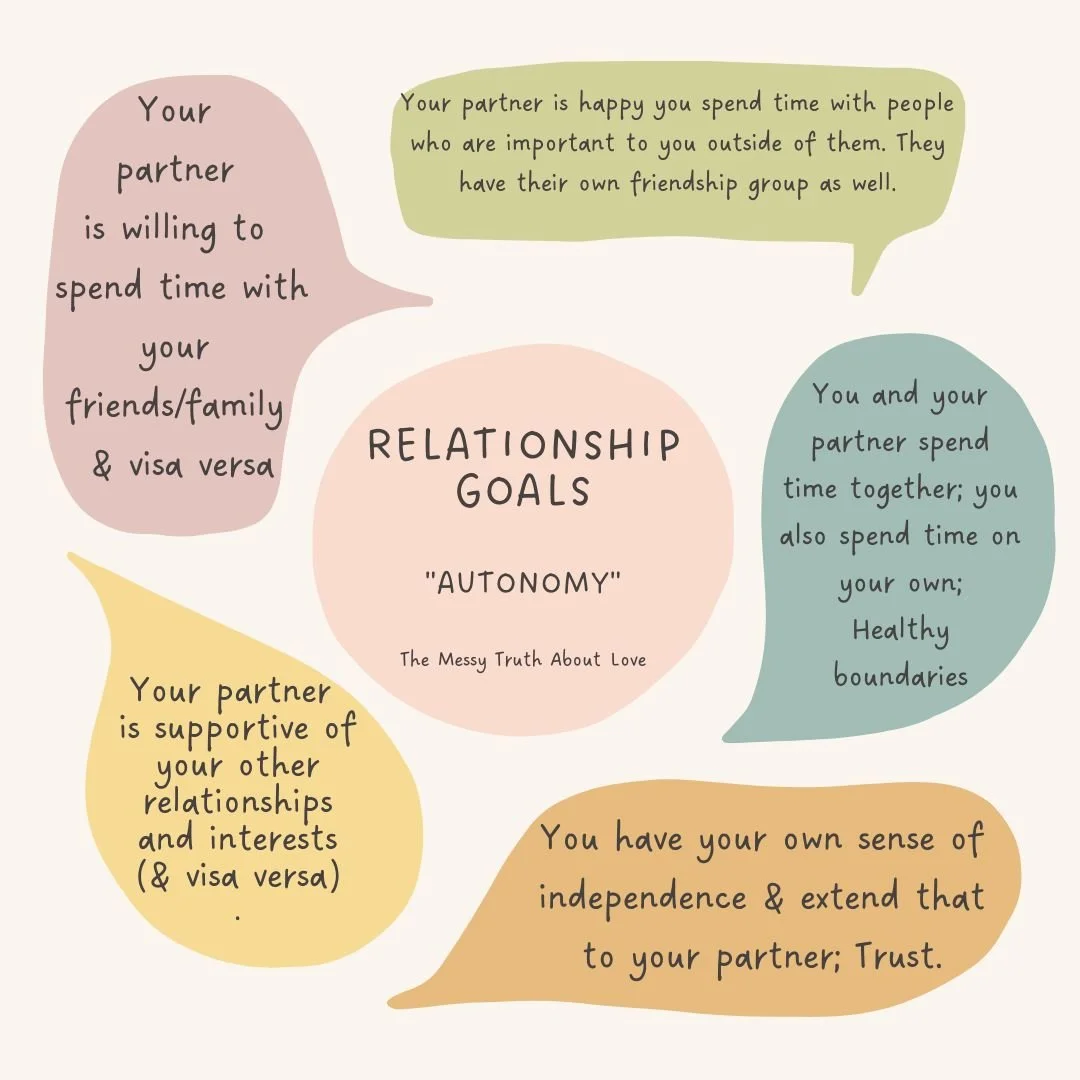
When I met my now husband, I wasn’t in the best mental space. I was a first-year college student who hadn’t left her hometown for a bunch of reasons, and ended up enrolled at her local college. A fortuitous convergence of events, really, because had it not worked out this way, I wouldn’t have met my guy. But that doesn’t mean it was smooth sailing. Nope. Both of us were willing to work through the junk in each of our individual lives (not always in pretty ways) to be together. But when we were younger and full of our insecurities, we weren’t always healthy in our approach to our own lives both on our own and together. My life became about him. His became about my adoration of him. While we didn’t display those red-flag tendencies (see graphic below), both of us potentially could have fallen into this trap.

Aging is a great perspective builder. Having been together for over twenty-five years, we aren’t the same two people we were in our early twenties (thank goodness). I’m happy to report that time, education, and experience has supported us to be a better version of a couple. A healthy one (see graphic). He’s pursuing his dreams and supports me in pursuing mine (and vice versa), both of us recognize the strengths each of us bring to the relationship to make us better as a couple.

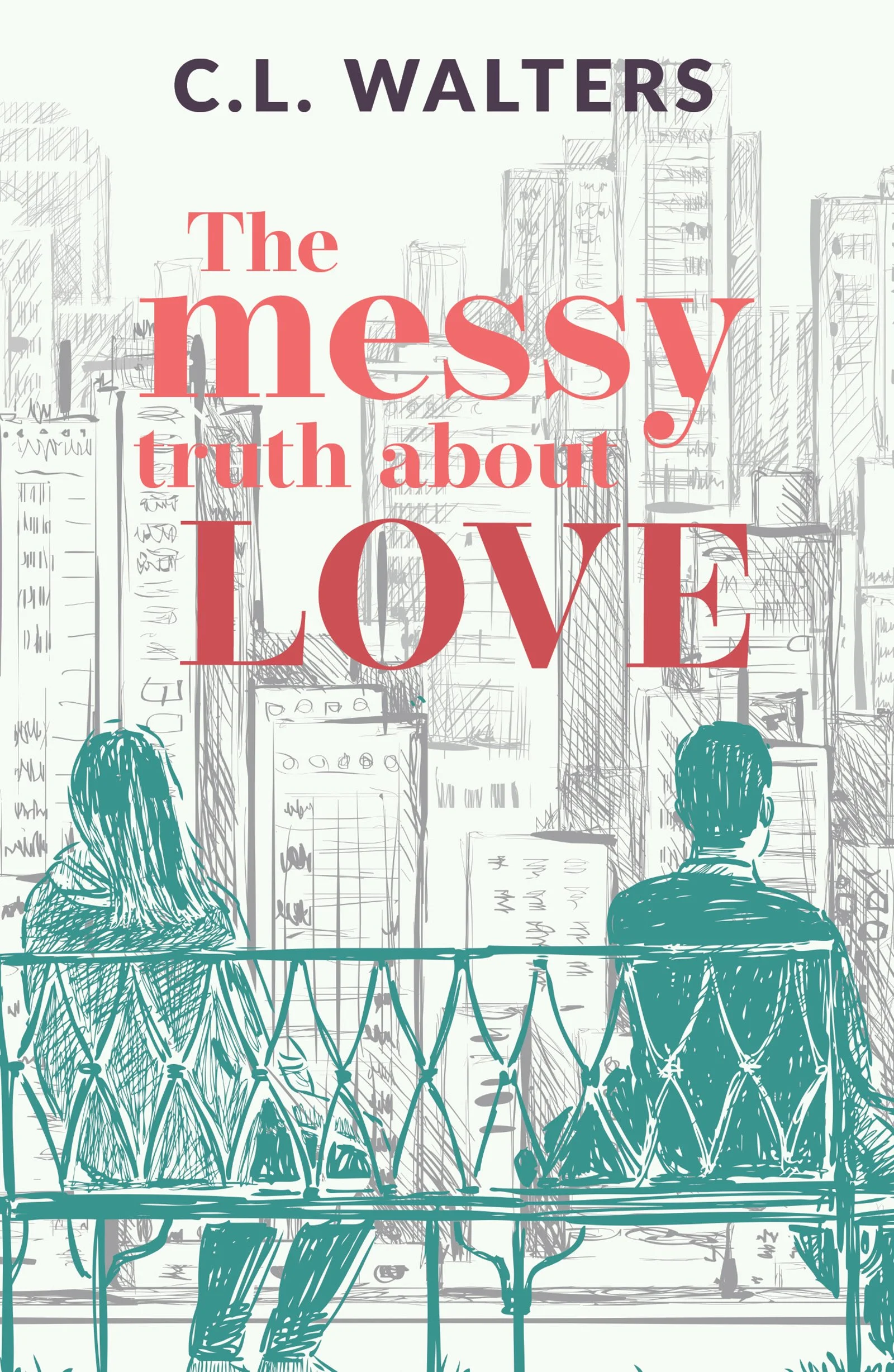
In the Messy Truth About Love, Hannah and Seth had a crush on one another in high school but other than a make-out session, that’s as far as it went. Seth mentions that being with Hannah “was like climbing a mountain he didn’t have the tools to climb.” Having been the victim of child abuse, Seth has done work on himself with therapy when he and Hannah reconnect. He’s becoming a better version of himself with access to better tools. Hannah, however, is getting out of a relationship that unfolds waving red flags at the reader. In the story when Hannah and Seth reconnect as more self-aware people, they have to work through the individual spaces in their own experiences and figure out what that looks like as a couple. It isn’t always pretty.
The Messy Truth About Love was a difficult book to write for the very reason it takes the reader into uncomfortable places in unhealthy relationships. One of the common bits of feedback I have gotten, however, is how important the story is to share. How many people who have read it mentioned they have identified in some way with the journey and wished they’d had something like this book to help them through the confusion. It isn’t a preachy book, but hopefully it’s one that provides perspective that each person has value in and of themselves beyond any relationship that they might be using to define them.
The Messy Truth About Love is available for preorder and signed copies can be purchased up to September 6. It publishes on September 6, 2022.
Relationships: Beware Gaslighting

This isn’t a blog to explore the how, the what, the what-to-do with respect to gaslighting. Remember I’m not a psychologist or a therapist, just an author who’s done a bit of research for their book (Here’s a link to a resource written by someone more in-the-know than I am). The purpose of this blog is to consider gaslighting in terms of the “everyday” relationship. Ultimately, this sinister form of manipulation culminates when the victim questions their sanity, but that’s not how gaslighting begins.
Relationships are tricky creatures from the get-go. Typically two people with distinct personalities are working to come together and maintain a bond. This is difficult for two people with completely healthy approaches to relationships and communication. Add complicating factors like mental health issues, trauma and/or abuse, addictions, different perspectives, varied life experiences, so on and so forth, and the playing field went from being rolling hills to the Rocky Mountains.
Gaslighting, then, is one of those insidious tools used between partners to manipulate the other’s emotions. Like the love bomb, it isn’t necessarily something that is easily identifiable, especially when trust has been established in a relationship and if you aren’t sure what to look for. Here’s an example of how gaslighting might look in a typical relationship:
Let’s pretend you’ve had the feeling that your partner isn’t being completely honest with you about what they’ve been doing. Your spidey-senses are tingling, so you decide it's time to ask about some things you’ve noticed, at least to calm your insecurities. When you ask your partner about the late nights and the strange hushed phone call from the other night, your partner twists your questions back on you as if what you’ve made are accusations, and suddenly you’re being accused of being a liar. That perhaps you’re “making up '' mysterious phone calls and accusing your partner of being late because you’re doing something wrong while they’re away. Your partner might say, “Guilty people make accusations about what they’re doing wrong to deflect, afterall.” Your partner’s guilt trip about your lack of trust and oversensitivity throws you off since that’s not what your intentions were. Right? Maybe your partner is right. You struggle to recalibrate your thoughts, because what started as just a conversation to “clear the air” has you defending yourself, doubting your intentions and your feelings, along with doubting your instincts.
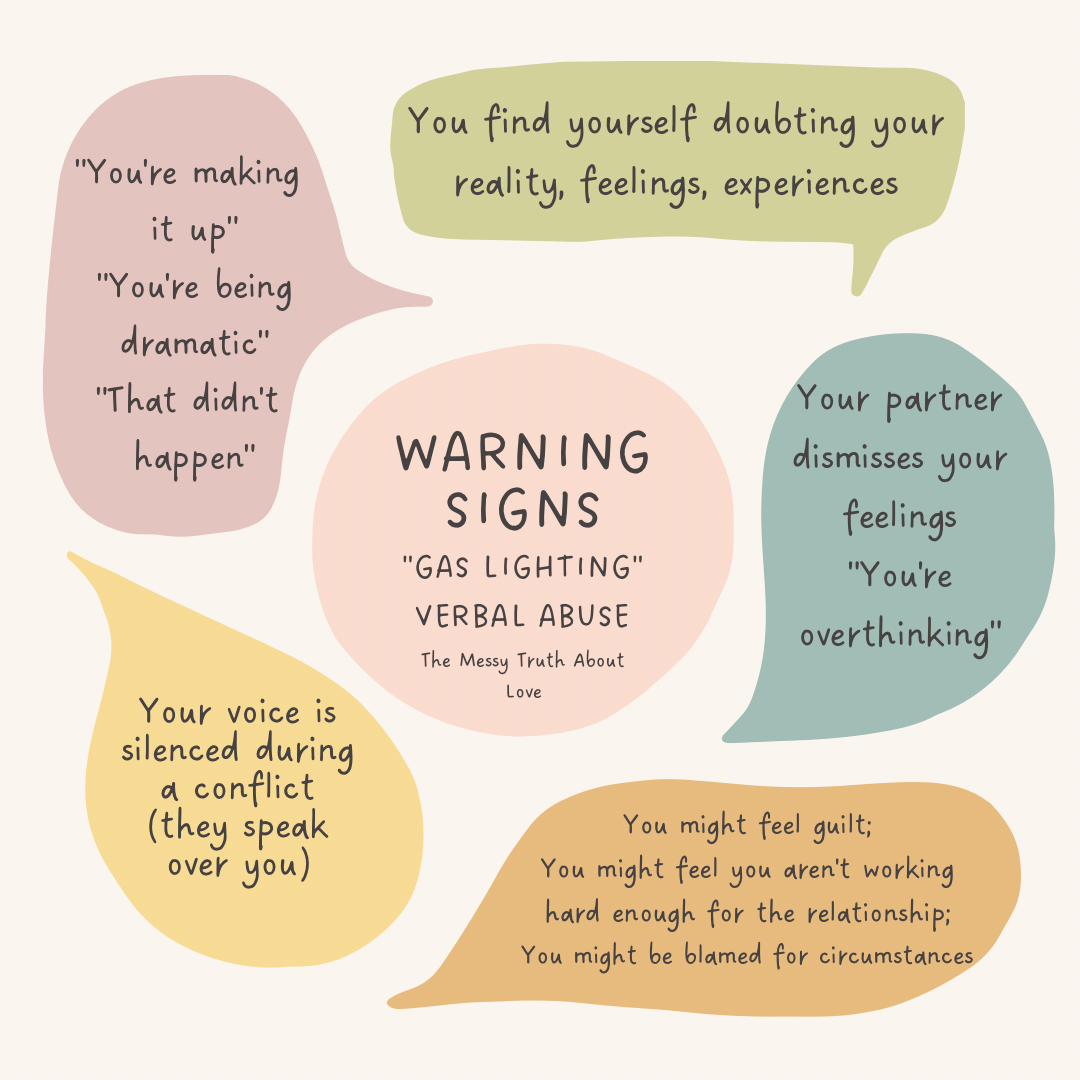

The thing is, even normal, everyday, regular people can deploy a “gaslight”. This isn’t only a tool of the shady or the narcissist or the sociopath. It is a learned tool—a form of avoidance and deflection—which makes it important to be able to identify one and call the behavior out immediately. In The Messy Truth About Love, Hannah’s ex-boyfriend used this technique, calling her “over-sensitive” and “dramatic”. The awful thing about persistent gaslighting even in a “typical” relationship is the ugly way it preys on beliefs about self, feeding on insecurities and forcing those wounds to grow and fester.
If your partner uses this tool, it's important to call it out for what it is. You might need help with this, so find help! And if your situation is abusive, seek help immediately.

The WHY Behind The Messy Truth About Love
The Messy Truth About Love has been out for over a month now and I waited to write this post to avoid any spoilers, but I think its safe to explore this topic further without harming your reading experience. But in case you want to read The Messy Truth About Love without them, then probably stop reading NOW.
Here are the trigger warnings, just in case you need them
Ready to read more behind-the-scenes? Scroll for more…
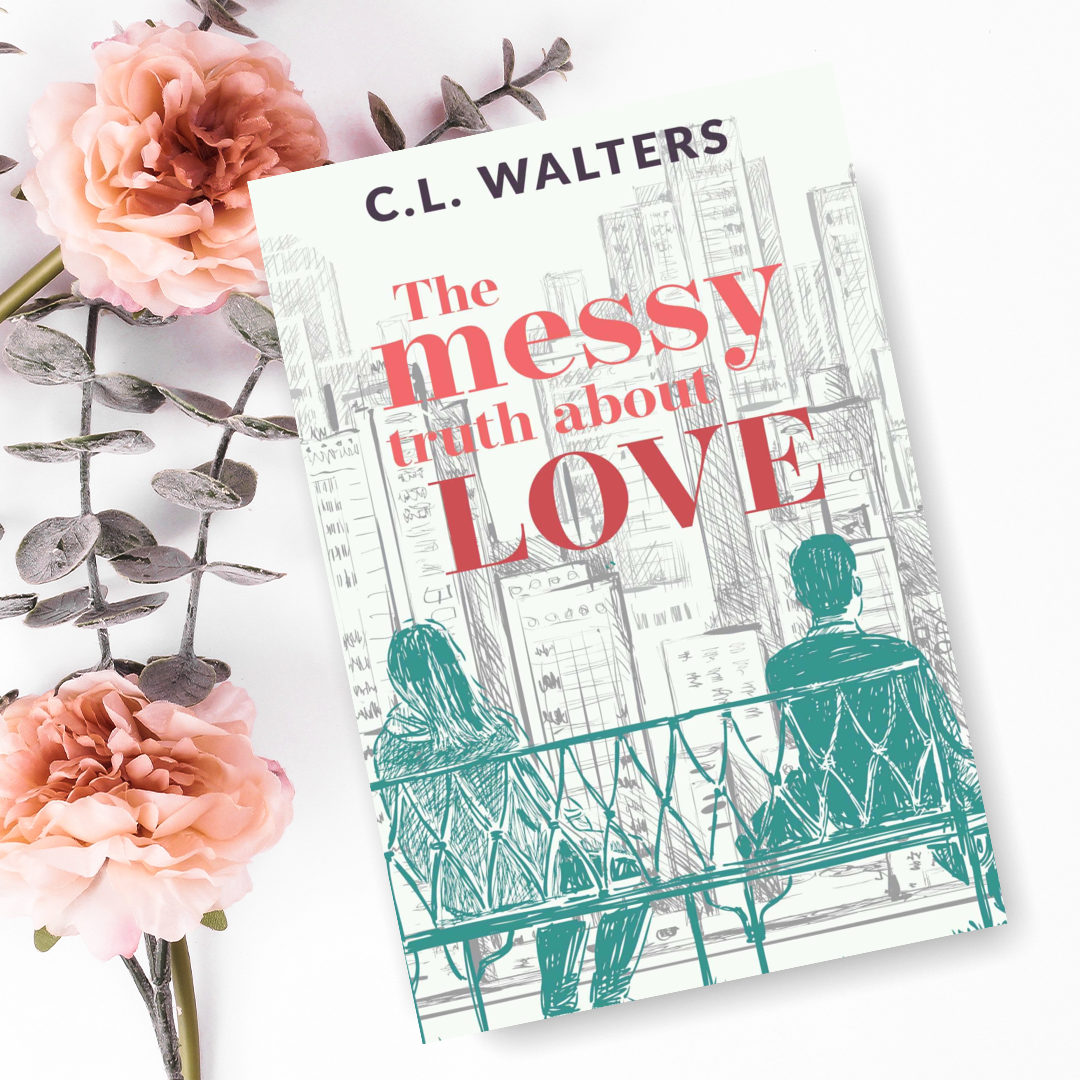
When I set out to write The Messy Truth About Love, I had no idea that it was going to dive into an abusive relationship. In fact, since I was writing about Seth (a reoccurring character from The Ugly Truth) I thought his mental health recovery in the midst of his own childhood abuse situation would be as dark as I dove. Only Hannah made me look closer at her relationship with her ex-boyfriend, Sebastian. And suddenly, I was researching abusive relationships and the warning signs.
I’d planned to publish the following “Author’s Note” here, but before I did, in a fortuitous convergence of events, I was listening to a recent episode of Crime Junkies Podcast that aligned with my own purpose. It was the story of Yeardley Love.
Yeardley was a fourth-year college lacrosse player when her life was cut short in a domestic violence event. Her on-and-off-again boyfriend, also a fourth year college lacrosse player, in a fit of drunken rage, attacked her, killing her. He was arrested, found guilty of 2nd degree murder, and sentenced to 23 years in prison. That can’t bring back Yeardley to her loved ones, but they sought to honor her memory. In order to combat the pervasive way domestic violence haunts our society, Yeardley’s family started the One Love Foundation to offer education and support, specifically to college students, as they navigate their relationships. I plan on supporting with a portion of the proceeds from The Messy Truth About Love.
Here’s why (from my Author’s Note):
In 2020 the #blackandwhite challenge circulated on social media. Women posted a black and white picture of themselves to highlight empowered women, only I remember learning after the fact that the impetus of the black and white photos got lost as if we were playing a game of telephone. The origin of that particular “challenge” was rooted in Turkey when women woke up to yet another black and white photo in the newspaper of another murdered woman. This time it was of Pinar Gultekin, a 27-year-old Turkish woman who’d been murdered—strangled, burned, then buried in concrete—by her ex-boyfriend in what was called an “honour killing.” Why? Because she told him “No.” Because she didn’t want to date him. Because she had moved on, he hadn’t and decided to choose for her. The unfortunate reality is that Gultekin’s photo in the newspaper was one of many black and white photos of murdered women in Turkey. Fed up and needing a way to fight back, Turkish women created the black and white photo reminder to increase awareness about the horrifically high femicide rates, specifically in Turkey, at the hands of their intimate partners.
They wanted change.
Pilar Gulekin’s story might have appeared in black and white—a photo and words on the page—but her life was lived in color, in a collection of experiences and relationships that made her a real human. Just like the many other stories and statistics we’re able to access in black and white, but rarely offer the color image.
Consider these black and white statistics from the United Nations and the World Health Organization:
Of the approximately 3.9 billion women in the world, over 736 million of them have been subjected to physical or sexual violence in their lifetime. It roughly estimates to 1 in 3 women though this statistic doesn’t include sexual harassment.
Most violence against women is committed by intimate partners or former husbands, and for those women who have been in an intimate relationship, 16% of those women will experience violence perpetrated by their partner against them.
In 2020, 81,000 women and girls were killed, and over half of those were at the hands of their intimate partner or other family member (and that’s only the ones we know about).
Less than 40% of women who experience violence at the hands of family or an intimate partner seek help, and less than 10% of those reach out to law enforcement.
Globally, violence against women disproportionately affects women in lower-middle- income situations.
I’m a fan of Crime Junkies (the true-crime podcast) and watching true crime documentaries. I’m not exactly sure why that is, though due to their popularity, I know I’m not alone. Though many of these stories shared offer context and work to flesh out the truth for the victim, I wonder if they provide the listener with a voyeuristic ability to stand outside of it. As if we’re passing by a terrible car accident and need to see the gruesome reality but sigh with relief that it didn’t include us. What gets to me about these stories: most of the cases are crimes against women. I wish I was surprised by this, but the unfortunate (and frighteningly pervasive attitude) is that violence against women is the norm, and worse, the undercurrent that somehow it was probably her fault.
No one does black and white voyeurism better than Americans. We’re great about looking at a black and white photo of a woman who’s been murdered in Turkey and distancing ourselves from it. It isn’t in our country, right?
Except there are black and white statistics that say it is. A study done by Asher and Lyric about women traveling on their own in the world and how they might consider their safety relative to various locations in the world. Asher and Lyric ranked the countries using datapoints that examined things like “walking alone at night,” the country’s “homicide rates against women,” “nonpartner sexual violence,” and “partner sexual violence,” as well as “attitudes about women and violence against women in general.” Out of the 50 countries examined, want to know where the United States lined up? Nineteenth with a C- sandwiched between Tunisia and Ukraine. And get this, the United States ranked 7th highest for intimate partner violence (Only Brazil, Morocco, India, Thailand, Turkey, and Chile ranked higher in that category). Turkey was 5th.
Take that in for a moment. Turkey—where Pilar Gultekin was killed for telling her former boyfriend “no”—was only two spots higher than the United States.
We want to distance ourselves and claim that kind of violence doesn’t happen in the United States, but those black and white statistics don’t lie, those black and white photos in newspapers, and the words written to offer the latest true-crime story offer us surface level truth. We look closer—and every single one of us should be looking closer—tell us a deeper truth. Each of those faces, every single one of those names, and every statistic is linked to a full-color story. Like Yeardley Love.
Hannah’s experience in The Messy Truth About Love is meant to showcase the subversive way abuse occurs in an intimate partnership. I’m going to go out on a limb and make the claim that women don’t walk into a relationship thinking it will be or become abusive. Then once immersed in that situation, getting out of it isn’t a black and white solution of just walking away (even if we’d like it to be). How does one leave without financial stability? What if there are children? Does she have supportive friends and family to help her? What if she goes to school with her abuser, like Hannah? And even if a woman leaves, what if their partner doesn’t get the message? What if he doesn’t adhere to the law? Or what if there aren’t any laws to protect her?
Hannah’s experience in this story is mild (I needed a positive and hopeful ending, folks). She’s a singular perspective. The truth is that the women most adversely affected by these black and white statistics are women of color, women immersed in low socio-economic circumstances, trans women. I can’t trivialize women’s experiences to say that their stories all wind up hopeful and positive like Hannah’s. There are too many cold-case files, too many murders, too many statistics, too many young children without mothers, too many stories to say that women’s stories aren’t happy or hopeful. It’s heartbreaking.
I need hope.
And yet, I don’t have anything very hopeful to offer with respect to this issue. I don’t have that glimmer of light to say: “Look! We can get better.” Only after I wrote this, our nation’s highest court overturned the landmark Roe versus Wade reversing women’s bodily autonomy. So my hope meter feels like it’s running a little low. Why? While body rights may seem a separate issue from intimate partner violence, they aren’t that disparate. Both issues communicate an attitude about women and where her agency lies, both of which say it’s outside of her own autonomy and in the hands of someone else. As Americans we want to distance ourselves and say intimate partner violence isn’t an American problem, but it is. It’s a national problem. It’s a global problem.
If you are a woman in trouble, please reach out. Here are some national resources for you:
https://www.thehotline.org/ or 1-800-799-SAFE (7233)
https://www.rainn.org/ or 1-800-656-HOPE (4673)
https://www.joinonelove.org/ (a great resources to temperature check your own relationship. There’s an app as well and everything is confidential.
Please call 9-1-1 if you are in immediate danger
Latest Posts




-
September 2023
- Sep 25, 2023 Tanner's Story: The Bro Code Crew Sep 25, 2023
- Sep 25, 2023 The Thanksgiving Scene: Griffin and Maxwell Sep 25, 2023
-
August 2023
- Aug 13, 2023 In the Echo of this Ghost Town: Facing Fear Aug 13, 2023
- Aug 13, 2023 In the Echo of this Ghost Town: Choices and Consequences Aug 13, 2023
- Aug 13, 2023 A Letter from Maxwell (When the Echo Answers) Aug 13, 2023
- Aug 13, 2023 A Letter from Griffin (In the Echo of this Ghost Town Aug 13, 2023
- Aug 13, 2023 In the Wait: Matt Aug 13, 2023
- Aug 13, 2023 In the Wait: Jack Aug 13, 2023
- Aug 13, 2023 In the Wait: Carter Aug 13, 2023
- Aug 13, 2023 In the Wait: Sara Aug 13, 2023
- Aug 13, 2023 In the Wait: Gabe Aug 13, 2023
- Aug 13, 2023 In the Wait: Abby Aug 13, 2023
- Aug 13, 2023 A Letter from Gabe (The Bones of Who We Are) Aug 13, 2023
- Aug 13, 2023 A Letter from Seth (The Ugly Truth) Aug 13, 2023
- Aug 13, 2023 A Letter from Abby (Swimming Sideways) Aug 13, 2023