Character Speaks: Dear Sam, from Seth
From Sam (October 2019)
“…When I read, I often think of music that fits the situation […] for this little zine piece, [this is the music] I associated with Seth’s character.”

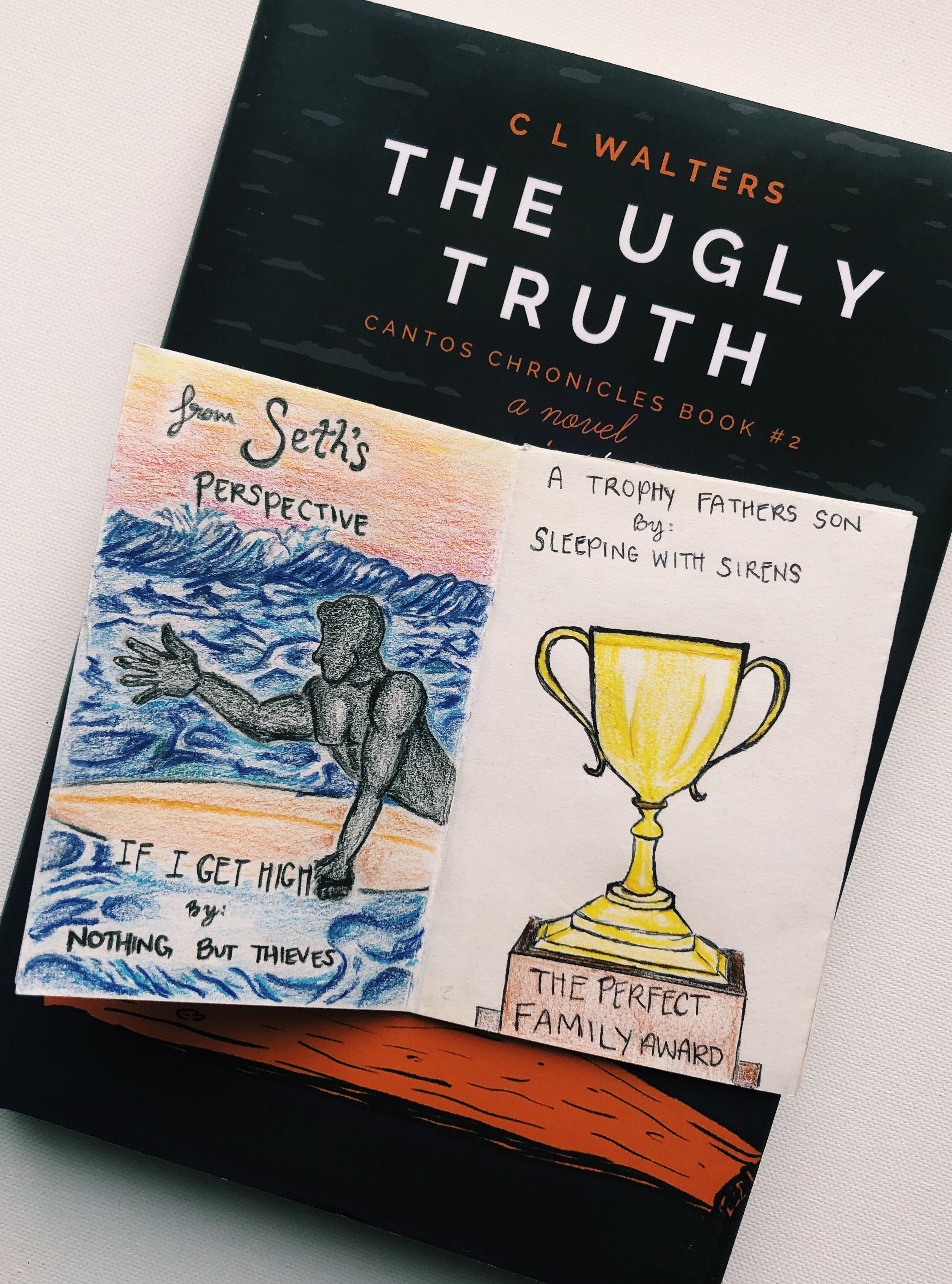
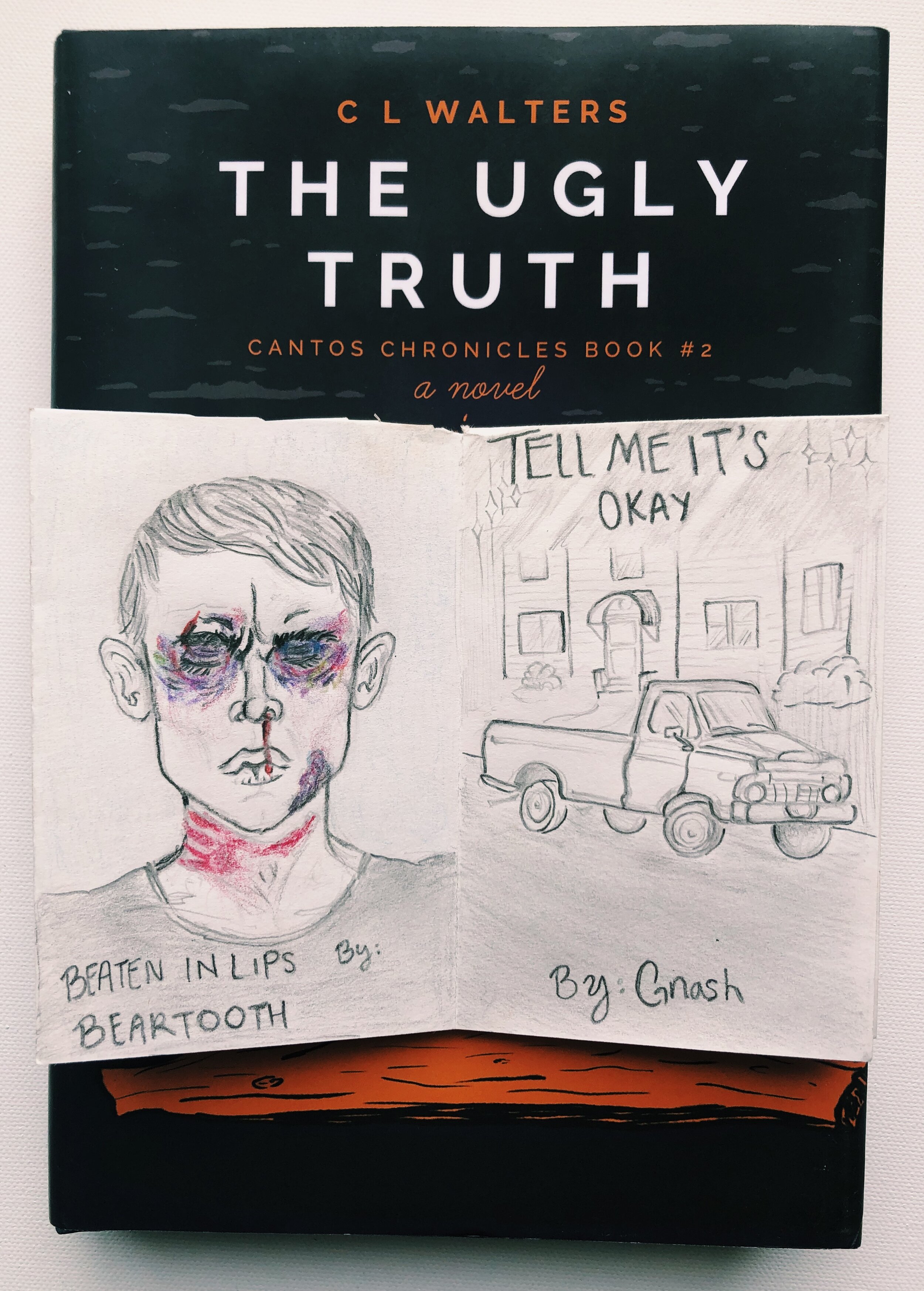
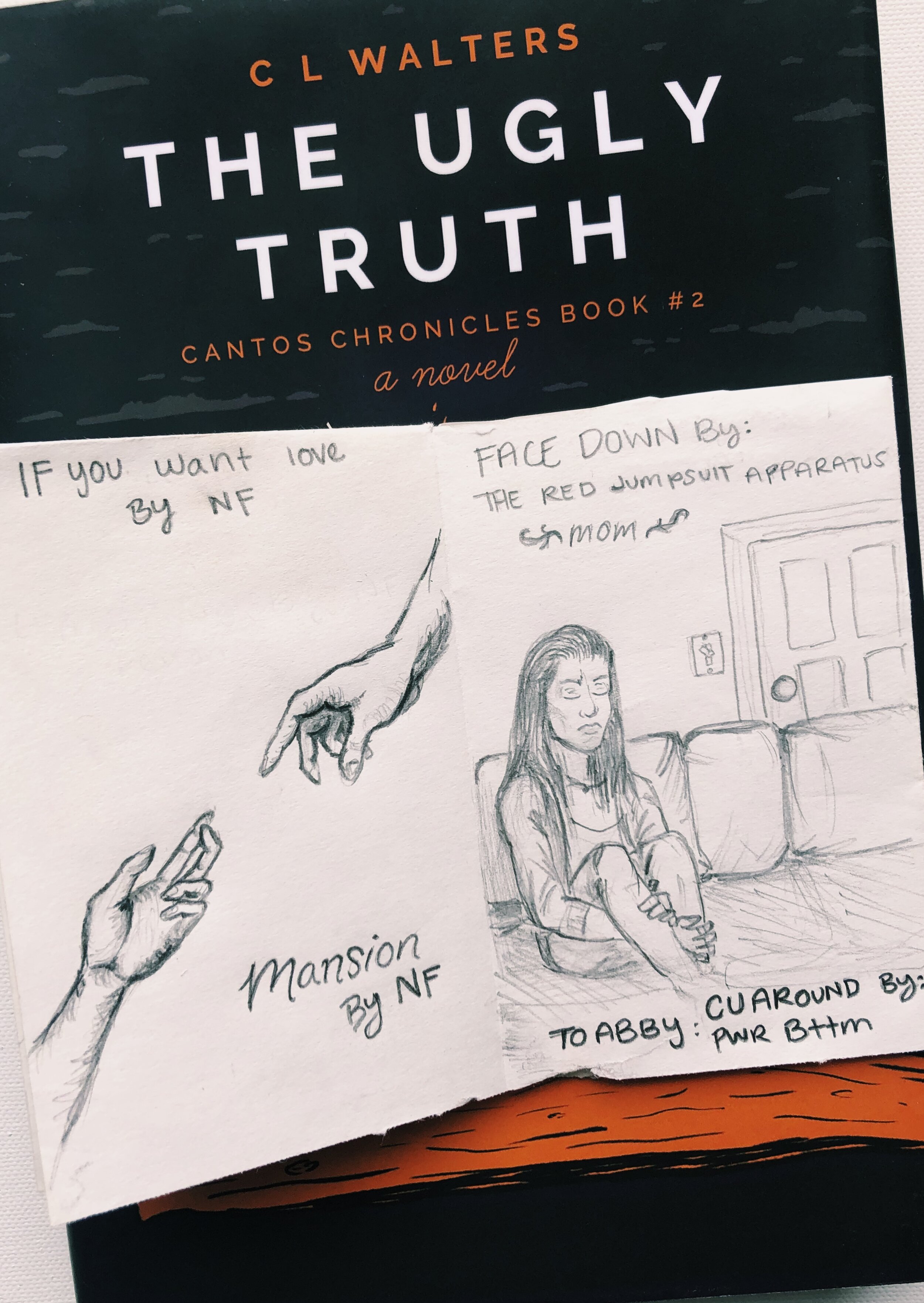
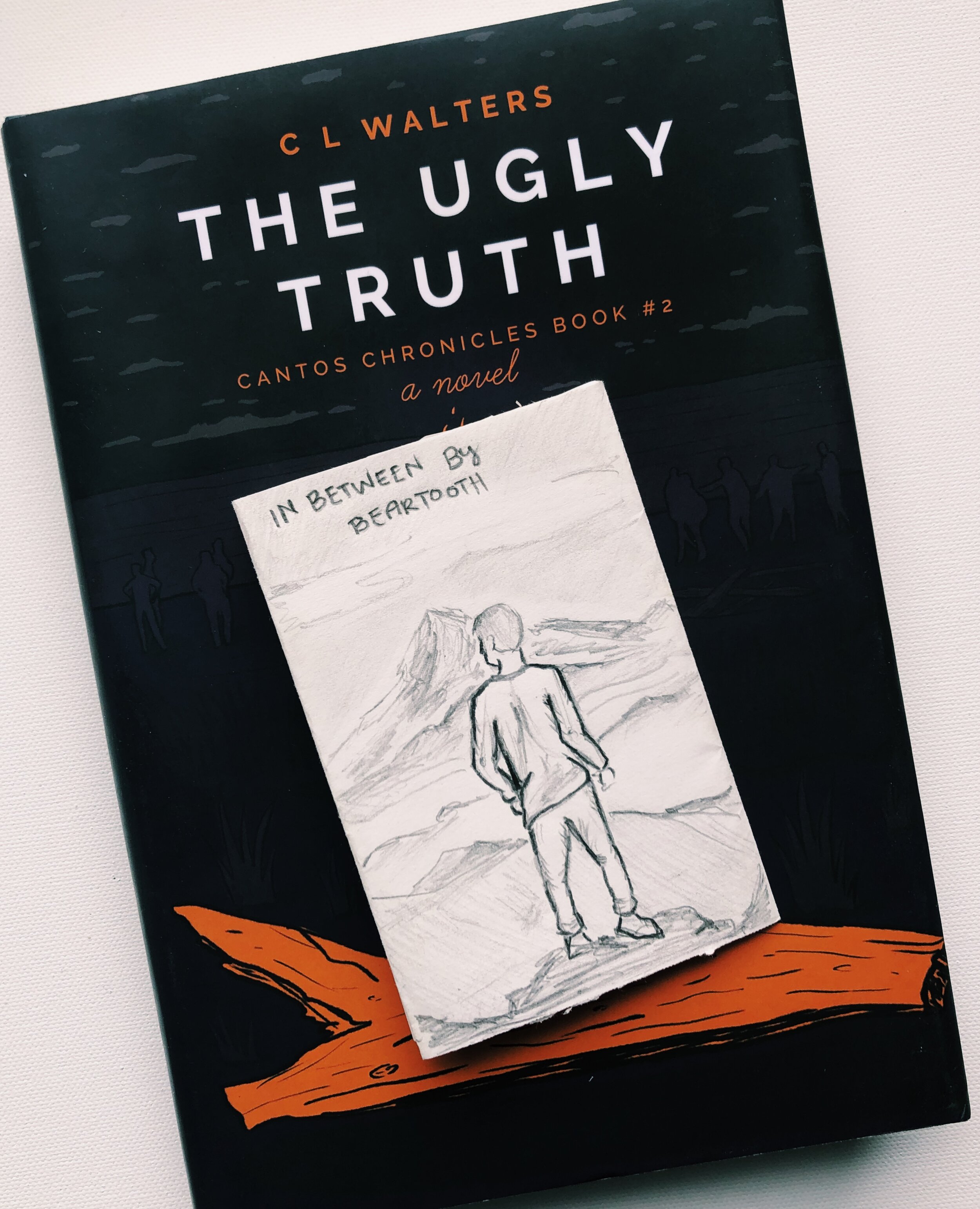
Dear Sam,
WTF?!? You took the time to make that cool zine? (What’s a zine anyway?) I can barely bring myself to work on my homework, and as you already know, my art consists of ripping up colored paper for a mosaic project. Paper, destruction, and glue. Sounds about right. I’m impressed by what you’ve made!
I listened to all the songs you suggested. Moody, monstrous, heartfelt are words that come to mind and for real, that was me, then. I think my favorite track is “If You Want Love” by NF. The pictures sort of hit me hard, you know, like I needed a trigger warning, but frick, my life then needed a trigger warning. Everything was so messed up. I think your art reflects the pain of that time. I’ve put your work somewhere safe, because I don’t want to take for granted my life. Ever. I can take out the zine and remember where I’ve been and what I’ve survived, you know?
The Ugly Truth is a story that feels so far removed from who I am now. Granted, it’s taken a lot of things to change. My parents separated after all that went down, but they agreed to therapy both together and on their own. I did too. Dad’s still sober, and they got back together during my senior year. Did you know we moved away from Cantos after I graduated? I’m in college now, and I’ve been through a few different therapists, but now I’m seeing this lady named Dr. Bethany. She calls me out all the time. I hate it and I love it. Does that make sense? She’s awesome.
It’s weird to think that my story connected to someone else, meant something. Makes it feel like sharing it was “right”. I guess that’s what stories are for, though. Connecting?
“Thanks for taking the time” seems like a trite way to say “thanks”, for this amazing effort of creativity on your part, but I do mean it. The zine is super cool. Really cool. I’m super stoked that I get to share it with others.
Keep surfing (whatever it is you surf), Sam.
Peace,
Note from the Author: Don’t forget to submit your letter, question for a character by February 22! You may be featured in the coming weeks. Email me or click the link to this FORM.
The Letters She Left Behind: Character Interview

The sun is shining on a December day in Hawaiʻi. Palm trees sway in a trade wind breeze and it’s balmy but cool, enough so that a light sweater is comfortable. Adam Kāne and Alexandra James agreed to take some time out of their busy schedules to speak with me about their starring roles in an upcoming novel, The Letters She Left Behind. This isn’t the first time I’ve met them. We met for the first time about sixteen years ago, then again just shy of a calendar year during the most recent revision of the story.
Having lived in Hawaiʻi most of their lives, both of them embody the lifestyle. Adam arrives first. He’s a Hawaiian local, born and raised on Oʻahu. He arrives like the gentle trade winds, calm and cool, as much a part of the landscape as the ocean shoreline he surfs, or the razor-sharp mountains that cut the sky. Dressed casually in black chinos and a white v-neck tee, people stop and greet him at our table. He seems to know everyone and people are drawn to him, but it isn’t just his manner of dress or his handsome demeanor. His smile is bright infectious, reaches his brown eyes drawing in those he talks to and makes it easy to spill secrets. In fact, he is more apt to listen rather than talk though he has so many things about which he can discuss.
Alex - arriving from her job as a gender studies professor at Hawaiʻi State University - wasn’t born in Hawaiʻi. Actually, she admits to being born on the East coast of the US, then moved across country with her family when she was around five to California. That’s where she met Megan (Adam’s late wife), who she refers to as her sister. Like Adam, she embodies island living. Her sleeveless coral linen dress translates not only to local but equally to those students she might be teaching who aren’t from Hawaiʻi. While I observed her and her conversation with Adam, I had the feeling I was the one being observed. Perhaps a bit of a chameleon, Alex is able to fit right into the moment of the interview, but it’s easy to imagine how she might command an auditorium full of students. She is independent, passionate and intelligent.
I was taken with their story. It stuck with me for sixteen years, so it made sense why I’d want to take some time to connect with them in the aftermath.
Thank you, Adam and Alex, for agreeing to talk with me about The Letters She Left Behind. I know that living in my head has probably been a bit stifling. Was it worth the wait?
Adam: Definitely. I’m a patient guy.
Alex: Sure, though it’s difficult sitting around and waiting for you to get your act together.
Hahaha! Wow. Okay. Why do I feel like there’s more in those answers than meets the eye.
Alex: I’m not one for being passive aggressive, CL, but you did write the story. You know.
Adam: (chuckles and shakes his head): Patience is a virtue. So is biting one’s tongue when necessary.
Moving on then. Without giving any spoilers, what do you like best about your story?
Alex: Megan. While she doesn’t make a huge appearance in the story, her part in the journey is equally important to the entire narrative on so many levels. I love that about her starring role. The way it all comes together.
Adam: Me too. I also like how there is the sense of time. The way life works sometimes to bend and twist in order to get you where you need to go when the timing is just right. It’s like as much as you might want something right now, it isn’t the right time for it.
Kind of like this story. Sixteen years ago, when I wrote it, I was in my early thirties and here I was writing about grief and second chances. Perhaps I needed additional time and world view to draw the story together. On another note, there’s this point in the narrative when both of you see yourself - or the truth of who you are - outside of the fear. Can you comment on how that moment or moments like that are impactful.
Adam: I know exactly the moment you’re referencing, though I would say I had more than one of these sort of ah ha moments. It’s like that one step forward, two steps back paradigm. A person discovers a truth about themselves. Moves forward and then regresses until another discovery occurs. I think most times, for me anyway, those self-discoveries or facing those honest truths can be painful, which is why we regress.
Alex: I think so too, which is why sometimes we don’t face them. It’s easier just to stay in one place because the threat of change might be more than we can accept. I know that for my part in the story, this fear of things being different was paralyzing.
I love that scene - when you walk into the ocean, Alex. It was pivotal for your character.
Alex: Yes. Truly makes the difference in the overall movement of my journey.
What about you, Adam? Is there a pivotal scene for your character?
Adam: There are a few, but I don’t want to give anything away by sharing them. I can say at the beginning of the story, I’ve been in a tailspin of grief for nearly a year. I’m raw at the opening, at the precipice of either burying myself in it completely, or doing something different. Megan’s journals were pivotal for me. Without them - well, there wouldn’t be a story.
Let’s talk a little bit about place and culture. As a Hawaiian, Adam, do you think your ethnicity is relevant to the story?
Adam: Not so much. I think I represent a Hawaiian male, but I don’t necessarily embody the cultural values of being Hawaiian, if that makes sense. In all fairness, I would add that who I am is on the edge of understanding my own Hawaiian identity. With the loss of language and culture, how does one rediscover those losses when you’re disconnected from them?
Alex: Do you think that lack of culture then misrepresents you in the story?
Adam: No. I feel like it accurately represents that it is a missing piece in my life, but more could be done to explore that. Maybe not in this story, but perhaps in others. But I think place is explored and the usage of ʻOlelo Hawaiʻi vocabulary which add depth to an understanding that Hawaiʻi is more than a tourist destination.
Funny you mention stories to explore that. I’m working on a story for Trey. I don’t know if it will be a short story or longer - beginning stages - but that idea of cultural rediscovery is a theme I’m noticing as I work on it. Speaking of secondary characters, who do you think will be a fan favorite?
Adam: The kids.
Alex: The kids.
Neither of you are partial… Why the kids?
Alex: Each of them are unique and bring a whole different dimension to the story. Without them, I think the story wouldn’t be as layered.
Adam: I agree. I’d like to see them all with their own stories.
What are you hoping happens with your story?
Alex: I hope that a reader can close the book and feel like “Wow, I don’t need to worry about that thing anymore.” I think it’s easy to get caught up in the minutia of our lives and forget the big picture, the what’s really important.
Adam: That! Yes. And to remember that life is a journey. It doesn’t stop. It moves forward and we move along the timeline with it. Sometimes we’re blindsided, sometimes we’re broken, but always the timeline continues. Something else I hope people remember - we can’t live it alone. Along the way, we need those special people to share it with in some capacity.
Thank you for hanging out in my head for a bit.
Look for The Letters She Left Behind on sale 1/14/20
Happy Book Birthday: A Character Interview
Interview with Adam Kāne and Alexandra James from…
The Letters She Left Behind
May 6, 2019

New romantic suspense book by CL Walters available May 7, 2019
Tomorrow is the book birthday for my new adult romantic suspense The Letters She Left Behind. In celebration, I thought I would commemorate the event with an interview of the main characters, Adam Kāne and Dr. Alex James. Born on the page in 2004, these characters have waited patiently for this author to rediscover them in 2019.
Some context for your reader imaginations:
Adam Kāne is a successful Hawaii business man at 47. He’s hard working, and loves his children. He misses his late wife and is in the late stages of grief at the opening of this story; he’s complex and definitely not perfect. Of course, he’s perfectly handsome - a gorgeous Hawaiian man (does Hugh Jackman with Hawaiian features help to picture him?).
Alex James - Adam’s counterpart - is an independent and smart woman. A forty-six year old college professor who’s bread and butter is Women’s Studies, she’s bright. But she also a fallible human woman who has secretly loved Adam for her entire adult life. She’s a beautiful, engaging, loyal, and funny. When I think of Alex - the beautiful Lauren Graham comes to mind.
So now, fifteen years after their creation … without further ado:
Welcome, Adam and Alex. I know that living in my head has probably been a bit stifling. Was it worth the wait?
Adam: Definitely. I’m a patient guy.
Alex: Sure, though it’s difficult sitting around and waiting for you to get your act together.
Hahaha! Wow. Okay. Why do I feel like there’s more in those answers than meets the eye.
Alex: I’m not one for being passive aggressive, CL, but you did write the story. You know.
Adam: (chuckles and shakes his head): Patience is a virtue. So is biting one’s tongue when necessary.
Moving on then. Without giving any spoilers, what do you like best about your story?
Alex: Megan. While she doesn’t make a huge appearance in the story, her part in the journey is equally important to the entire narrative on so many levels. I love that about her starring role. The way it all comes together.
Adam: Me too. I also like how there is the sense of time. The way life works sometimes to bend and twist in order to get you where you need to go when the timing is just right. It’s like as much as you might want something right now, it isn’t the right time for it.
Kind of like this story. Fifteen years ago, when I wrote it, I was in my late twenties - early thirties and here I was writing about grief and second chances. Perhaps I needed additional time and world view to draw the story together. On another note, there’s this point in the narrative when both of you see yourself - or the truth of who you are - outside of the fear. Can you comment on how that moment or moments like that are impactful.
Adam: I know exactly the moment you’re referencing, though I would say I had more than one of these sort of ah ha moments. It’s like that one step forward, two steps back paradigm. A person discovers a truth about themselves. Moves forward and then regresses until another discovery occurs. I think most times, for me anyway, those self-discoveries or facing those honest truths can be painful, which is why we regress.
Alex: I think so too, which is why sometimes we don’t face them. It’s easier just to stay in one place because the threat of change might be more than we can accept. I know that for my part in the story, this fear of things being different was paralyzing.
I love that scene - when you walk into the ocean, Alex. It was pivotal for your character.
Alex: Yes. Truly makes the difference in the overall movement of my journey.
What about you, Adam? Is there a pivotal scene for your character?
Adam: There are a few, but I don’t want to give anything away by sharing them. I can say at the beginning of the story, I’ve been in a tailspin of grief for nearly a year. I’m raw at the opening, at the precipice of either burying myself in it completely, or doing something different. Megan’s journals were pivotal for me. Without them - well, there wouldn’t be a story.
Let’s talk a little bit about place and culture. As a Hawaiian, Adam, do you think your ethnicity is relevant to the story?
Adam: Not so much. I think I represent a Hawaiian male, but I don’t necessarily embody the cultural values of being Hawaiian, if that makes sense. In all fairness, I would add that who I am is on the edge of understanding my own Hawaiian identity. With the loss of language and culture, how does one rediscover those losses when you’re disconnected from them?
Alex: Do you think that lack of culture then misrepresents you in the story?
Adam: No. I feel like it accurately represents that it is a missing piece in my life, but more could be done to explore that. Maybe not in this story, but perhaps in others. But I think place is explored and the usage of ʻOlelo Hawaii vocabulary which add depth to an understanding that Hawaii is more than a tourist destination.
Funny you mention stories to explore that. I’m working on a story for Trey. I don’t know if it will be a short story or longer - beginning stages - but that idea of cultural rediscovery is a theme I’m noticing as I work on it. Speaking of secondary characters, who do you think will be a fan favorite?
Adam: The kids.
Alex: The kids.
Neither of you are partial… Why the kids?
Alex: Each of them are unique and bring a whole different dimension to the story. Without them, I think the story wouldn’t be as layered.
Adam: I agree. I’d like to see them all with their own stories.
What are you hoping happens with your story?
Alex: I hope that a reader can close the book and feel like “Wow, I don’t need to worry about that thing anymore.” I think it’s easy to get caught up in the minutia of our lives and forget the big picture, the what’s really important.
Adam: That! Yes. And to remember that life is a journey. It doesn’t stop. It moves forward and we move along the timeline with it. Sometimes we’re blindsided, sometimes we’re broken, but always the timeline continues. Something else I hope people remember - we can’t live it alone. Along the way, we need those special people to share it with in some capacity.
Thank you for hanging out in my head for a bit. Happy Book Birthday tomorrow to The Letter She Left Behind!
Order here.
Character-Driven or Plot Driven Narrative?

Stories make me happy. This isn’t an overstatement. From sitting around the dinner table with family and listening to personal tales, or picking up a book and reading a gripping tale, I’m transported into the narrative, soaking up details and experience. Over the course of the last year, I read fifty books. These books ranged from memoirs like Trevor Noah’s Born a Crime, Maya Angelou’s essays in Letters to My Daughter and novels of varying genres from adult romance, thriller and suspense to young adult fantasy, dystopia, and contemporary. Stories make me happy.

Reading at the beach is even better!
As a writer - early on - as I was pushing open different kinds of writing doors to figure out what kind of writer I was, I didn’t think much about character. This isn’t because I had a belief that character wasn’t important. No. I knew characters were essential to the whole of a narrative. It was just that in my beginning level of constructing story, I focused on the plot to move characters through a story. The plot: a series of actions and reactions that carry characters from the beginning to the end of the story.
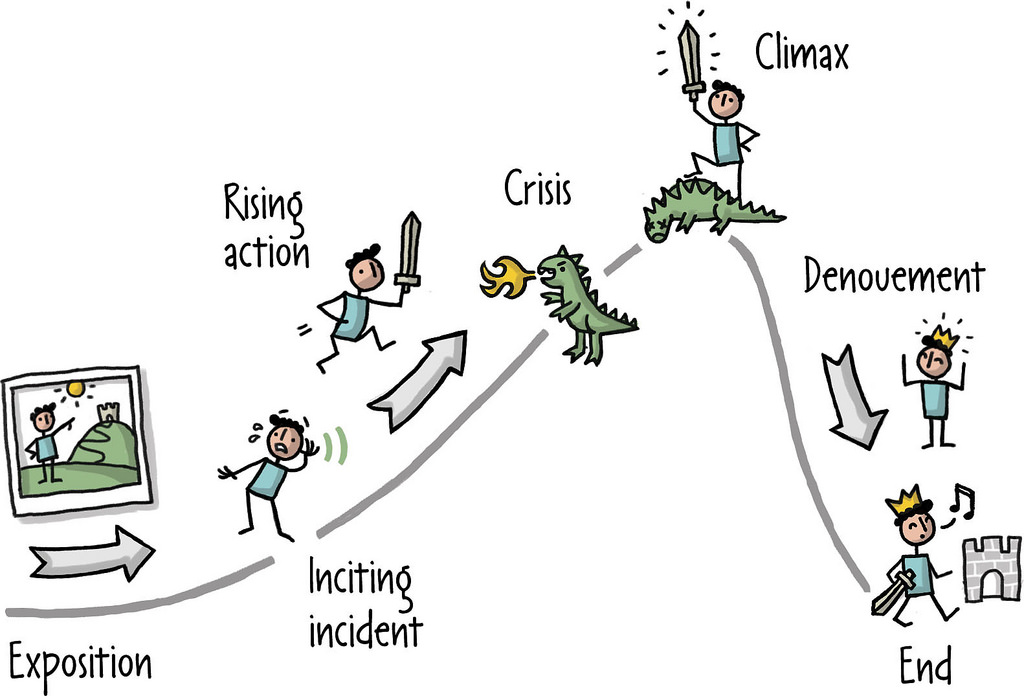
We’ve all studied it: Introduction, rising action, turning point, falling action, conclusion. First this happened, and then this and then this. I think many of us tell stories this way. As we recount a moment in our day, or for example, as my son recounted a dream he’d had to me. We describe the narrative as a series of events moved and dictated by the movement of our experience as characters in the story. This recounting is an example of the plot-driven narrative. A story moved by action from beginning to end.
Then, some of our stories investigate experience further. The narrative shifts into the thoughts and feelings associated with certain outcomes, and then we explore how those reflections inspired further action. When a story is driven by the internal experience of a character who responds to events taking them from one moment to the next reflecting on growth. This development of character motivation and internal exploration in response to action is a character-driven story.
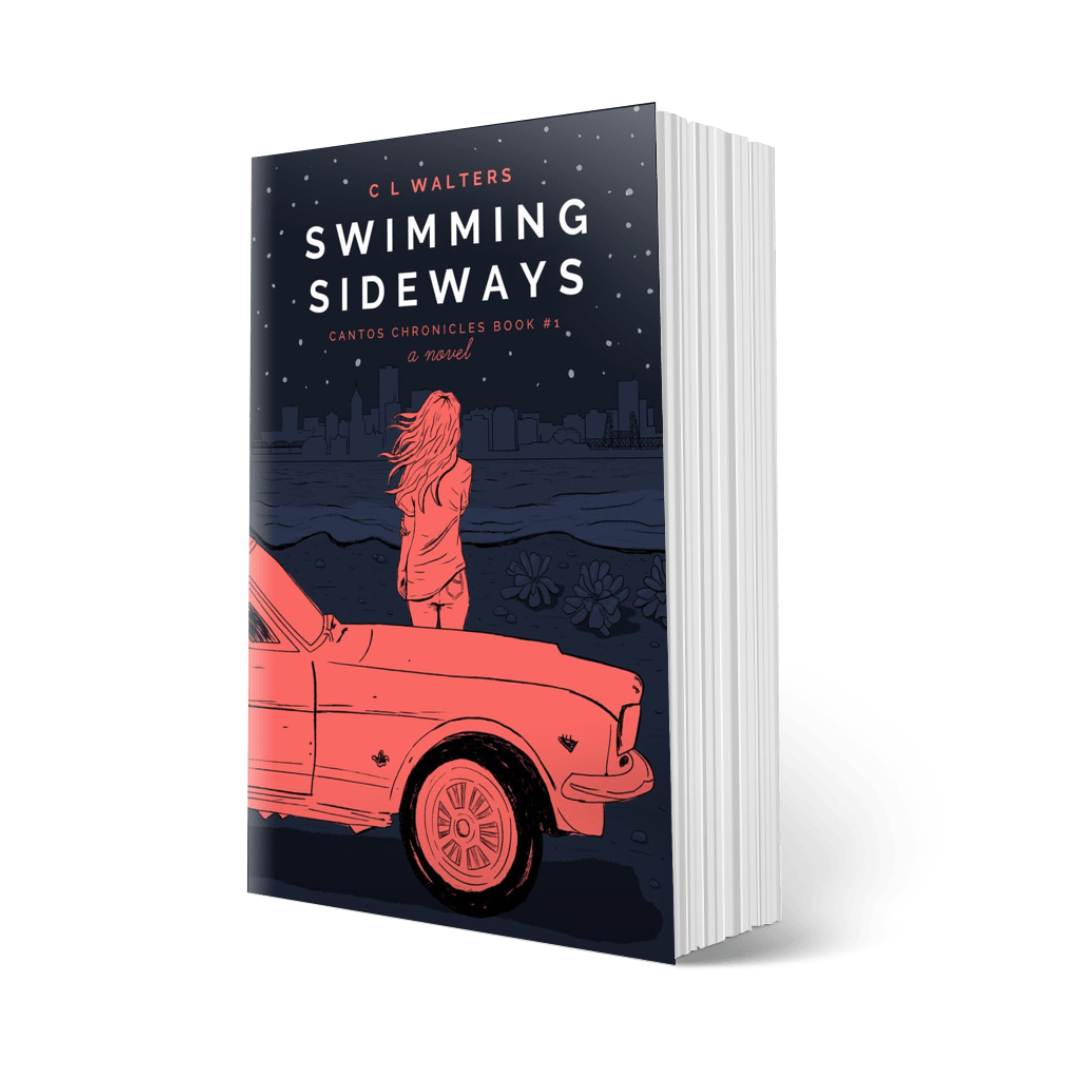
As I’ve developed as a writer (mostly by studying story after story after story, and then developing my own relationship to the craft of writing) I have moved toward a character-driven story. Looking at Swimming Sideways, The Ugly Truth and the soon-to-be published The Bones of Who We Are, I would describe them as character-driven novels in which the plot is centered on character growth rather than siphoned into a series of events.
This isn’t to say that one is better than the other. Both are embodied in well written stories. Both plot-driven and character-driven are enjoyable if written well. Though I would add the caveat that even plot-driven stories must have believable and developed characters. This is done, I think, by working to make characters round and dynamic versus flat and static. The difference? A round character is developed and complex rather than one-dimensional like a cardboard cut-out, and a dynamic character showcases a change in perspective whether this is through action, interaction, or internal development in contrast to a character who remains constant all the way through a story.

Consider your favorite stories. Would you say they were plot-driven or character driven? Feel free to comment and discuss.
Character: Conversations
When I tell people that my characters “talk” to me, I often get the look that indicates I might have a screw loose. Well, maybe I do. One of those tiny screws like on a pair of eyeglasses which needs one of those tiny special screwdrivers, because honestly, the rest of me is pretty factory settings.

When I say a character “talks to me” it’s literal. There is a voice inside my head carrying on a conversation. Sometimes it’s a one-sided monologue as the character tells me about something. Other times it’s a dialogue between the character and me. I become a reporter asking pointed questions trying to get to know him or her better. It’s an intricate mental dance. Okay, maybe not intricate, but certainly a dance.
The thing is, and I think lots of writers would say this. A character steps into the mind's eye in pieces. Maybe a smile that makes me curious, or maybe a one liner to another character which shocks me. And then I’m off and mentally running after her to understand what I just learned. “Why did you say that?” I might ask. It’s the dialogue - the talking - which fleshes out the character into a living being in my imagination. I will ask: what’s your favorite pizza. Seth said: Pepperoni. Abby said: I don’t really like pizza; cheese disagrees with me. Oh dear! I responded because cheese is like my favorite food. Gabe said: all the meats, to which I grimaced because I prefer veggie pizza.
In the development of my characters from main characters to secondary characters, I work to get to know them. I’ve noticed both as a reader and a writer, it is these details which help a character jump from the page. Understanding a favorite color, or favorite band, or whether she cleans her room or not helps the character become three dimensional not only for the writer but for the reader. For example: Seth keeps his room neat. Why? What is the underlying reason for this teenage boy to be so orderly and particular about his room? After talking to him, I learned it was about control. The detail - random at first - took on more meaning when I understood why.

In my writer’s process, what might begin as a conversation in my head leads to a sketched out conversation in my writing journal. The dialogue becomes questions I have followed by the character’s answers. I have learned when I get stuck in a particular scene, or in the narrative of the larger story’s picture, if I take some time to talk, the dialogue often clears up the jam.

An example from one of my writing journals. The highlight is me as the author asking questions.
As a reader, consider your favorite literary characters. I have a theory that the authors took some time to really understand the characters to help them leap from the page. As a writer: if you haven’t tried this (and probably most of us have) take some time to “talk” with your character. It’s easy. Start small with a “favorites” list, but as you continue, get to know their “greatest secret” or ask “the biggest fear.” Understand the nuances of the character whether it makes it into the story or not, and the character might walk from the page.
Latest Posts




-
September 2023
- Sep 25, 2023 Tanner's Story: The Bro Code Crew Sep 25, 2023
- Sep 25, 2023 The Thanksgiving Scene: Griffin and Maxwell Sep 25, 2023
-
August 2023
- Aug 13, 2023 In the Echo of this Ghost Town: Facing Fear Aug 13, 2023
- Aug 13, 2023 In the Echo of this Ghost Town: Choices and Consequences Aug 13, 2023
- Aug 13, 2023 A Letter from Maxwell (When the Echo Answers) Aug 13, 2023
- Aug 13, 2023 A Letter from Griffin (In the Echo of this Ghost Town Aug 13, 2023
- Aug 13, 2023 In the Wait: Matt Aug 13, 2023
- Aug 13, 2023 In the Wait: Jack Aug 13, 2023
- Aug 13, 2023 In the Wait: Carter Aug 13, 2023
- Aug 13, 2023 In the Wait: Sara Aug 13, 2023
- Aug 13, 2023 In the Wait: Gabe Aug 13, 2023
- Aug 13, 2023 In the Wait: Abby Aug 13, 2023
- Aug 13, 2023 A Letter from Gabe (The Bones of Who We Are) Aug 13, 2023
- Aug 13, 2023 A Letter from Seth (The Ugly Truth) Aug 13, 2023
- Aug 13, 2023 A Letter from Abby (Swimming Sideways) Aug 13, 2023